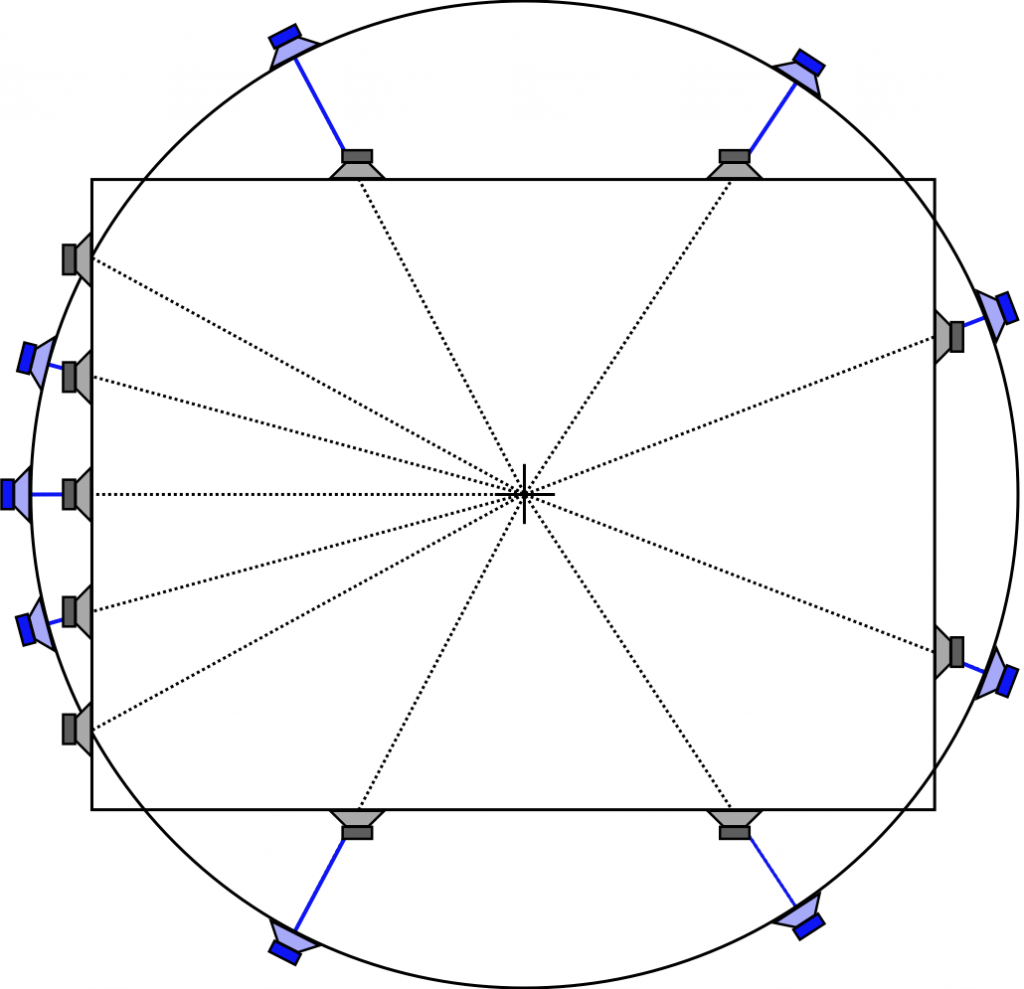
The implementation of a spatialized sound system depends on the architectural context of its deployment. As a result:
- its distribution will never be perfectly uniform.
- loudspeaker density will vary locally.
- loudspeakers will not be ideally equidistant from the sweet-spot.
- Perceived sound levels will not be perfectly identical at the sweet-spot.
Apparent source width: “spread”
Angular amplitude panning algorithms always use the smallest number of loudspeakers possible. As a result, when a virtual source moves, its apparent width will vary, ranging from a single loudspeaker to several loudspeakers.
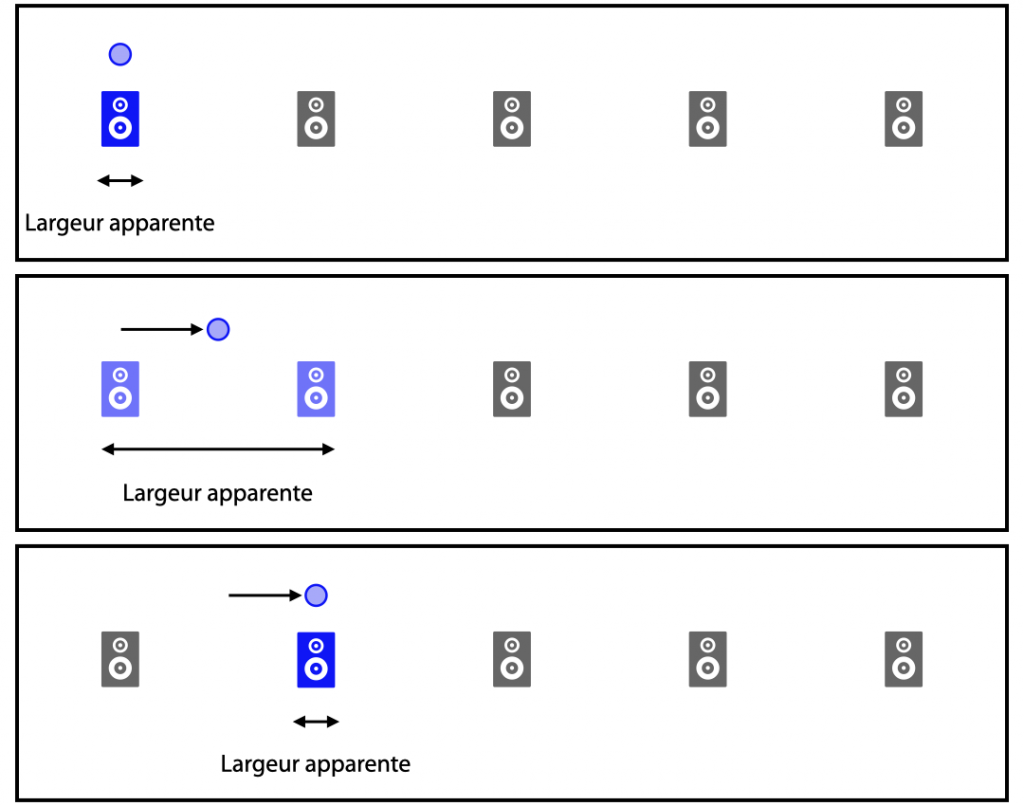
Furthermore, with heterogeneous loudspeaker distributions, the apparent width of the source will vary from a denser zone to a sparser zone.
In the example below, the zone containing the front loudspeakers is much denser than the surround zone.
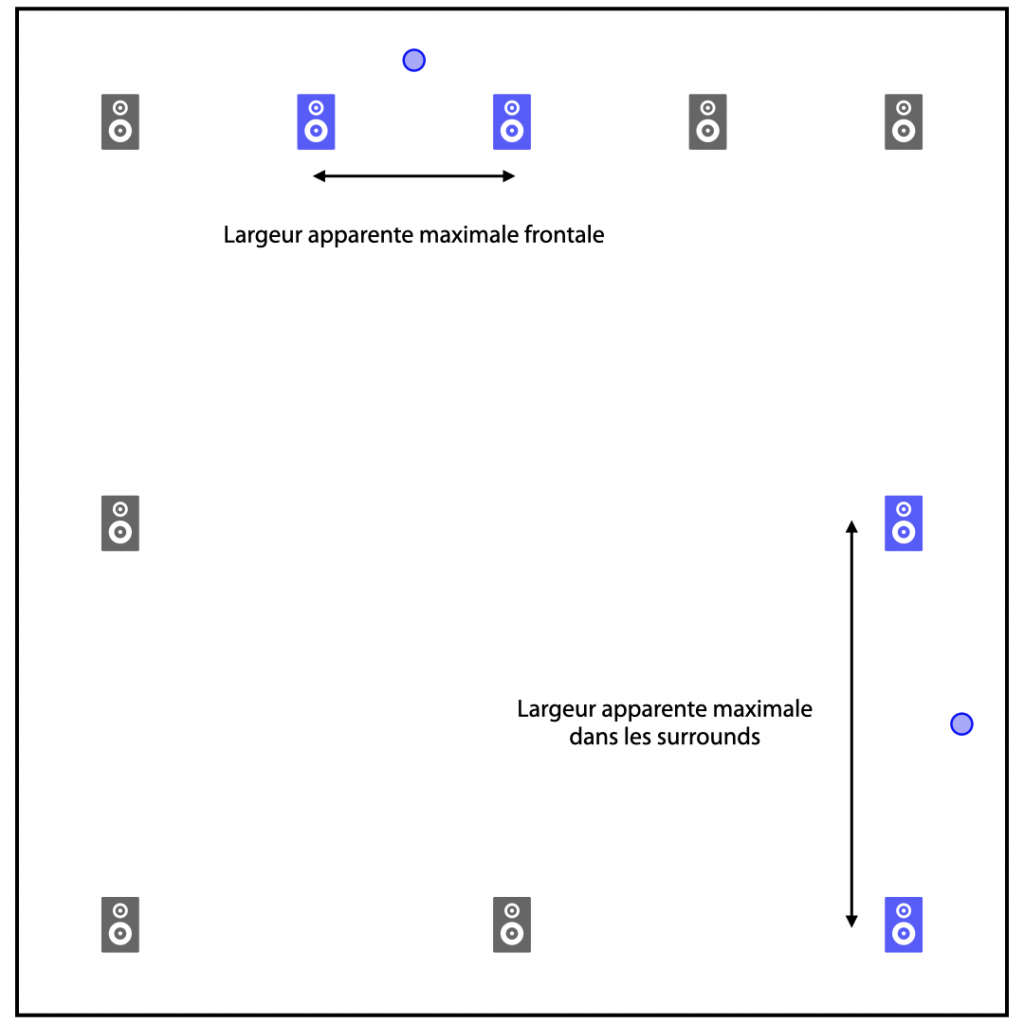
Frontally, the maximum apparent width of the source is smaller than in the surrounds because the loudspeakers are closer together, and conversely in the surrounds the maximum apparent width of the source is larger because the loudspeakers are more spread out.
These issues can be resolved by increasing the spread, to achieve a constant apparent source width during movement.
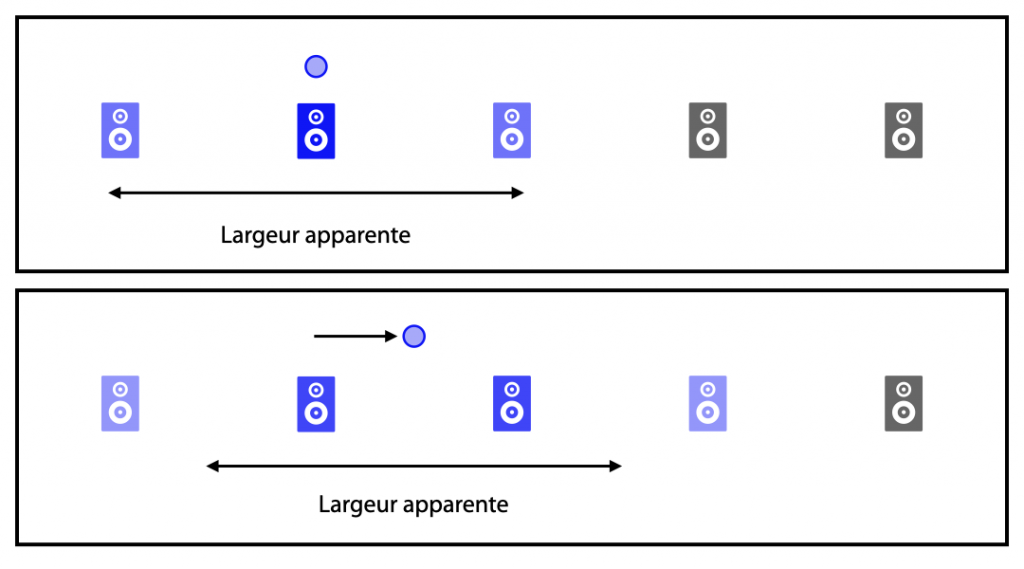
However, care must be taken not to distribute the source across too many loudspeakers, as this can cause critical coloration of the signal (increase in low frequencies, comb filter coloration) due to sending the same signal to multiple loudspeakers.
Finally, for heterogeneous configurations, another solution is to aim for a more regular distribution by using fewer loudspeakers from the densest zone: this avoids distributing the source signal across too many loudspeakers.
To this end, Holophonix allows selecting which loudspeakers to include in a bus and therefore in a spatialization algorithm. This choice allows integrating loudspeakers while taking into account a more homogeneous spatial distribution: for example, and subject to other considerations to come, when integrating the elements of a WFS line with a surround network.
Gain and delay compensation
Angular-based algorithms are designed to take into account only the azimuth and elevation of loudspeakers. Regardless of the distance between the loudspeaker and the center, it will receive the same signal level from a virtual source in a given direction.
In most configurations, loudspeaker distances from the center are not constant, thereby altering the homogeneity and temporal coherence of the signal at the center of the room. Using the Gain Compensation and Delay Compensation parameters in the Speakers Parameters window can be useful to compensate for this effect.
In automatic mode, gains and delays will be calculated to align loudspeakers as close as possible to the surface of a sphere whose radius corresponds to the distance to the center of the farthest loudspeaker.