
Angular amplitude panning algorithms work by reproducing a phantom source between two or three loudspeakers (in 2D and 3D respectively). They are found in traditional stereo or multichannel panning.
In the case of stereo panning, if the same audio signal is applied to both loudspeakers, a listener positioned in the center (facing both loudspeakers) will perceive the sound as coming from a fictitious point located midway between the loudspeakers. This point is called a “phantom image”.
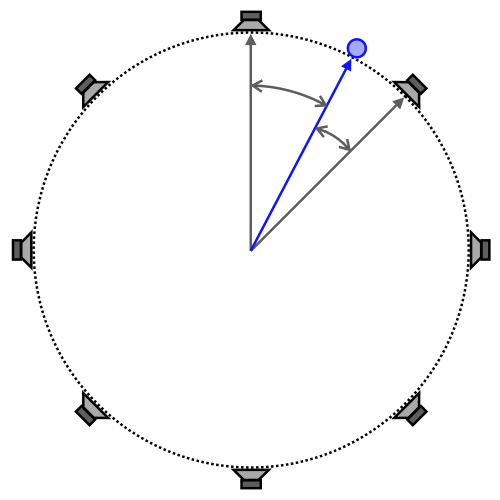
Panning of a source based on its angle between two loudspeakers on an ideal circular network.
By varying the sound level difference between the loudspeakers, the position of this phantom image can be shifted; it can be spatialized. Angular amplitude panning algorithms extend this principle to multiple channels, as if multiple stereo pairs had been placed end to end (in 2D) [1].
With angular panning, the sound level of the source on each loudspeaker depends on the angle separating the virtual source from the adjacent loudspeakers (figure above).
All angular algorithms require that the origin of the coordinate system be positioned at the center of the loudspeaker array. Otherwise, angles cannot be calculated and the algorithm will not function.
[1]: In 3D, adjacent triplets or triangles of loudspeakers are used.