
LBAP (Layer Based Amplitude Panning) is a relatively recent technique, introduced in 2016 by Ivica Ico Bukvic at Virginia Tech in the United States[1]. Its primary objective is to define an amplitude panning approach optimized for loudspeaker distributions organized in distinct layers, each of which can have a heterogeneous arrangement.
The algorithm performs amplitude panning using the two layers adjacent to a source. For each layer, it first applies pairwise amplitude panning (VABP 2D): between the two loudspeakers closest to the source. Finally, depending on the elevation, it applies a different level between the layers.
If a source is perfectly aligned with a loudspeaker, only that loudspeaker is fed. Conversely, when a source is positioned between two loudspeakers, only those two are used. Thus, the algorithm always uses the four loudspeakers surrounding the source.
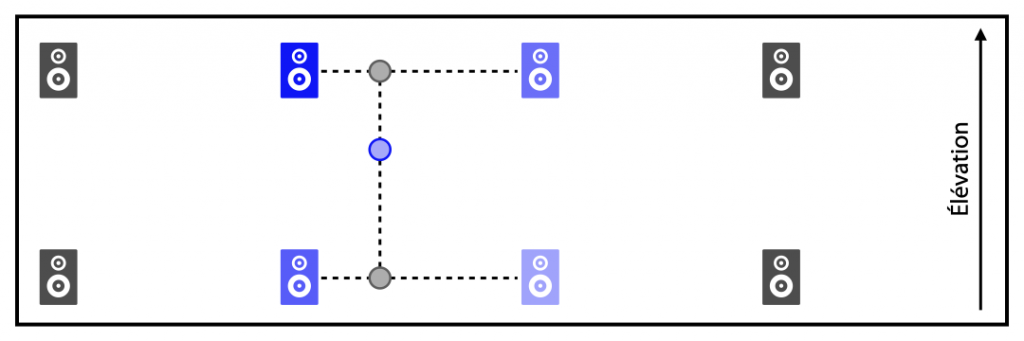
Comparison with VBAP in 3D
This algorithm therefore presents itself as an excellent alternative to VBAP 3D for the vast majority of setups encountered in theatres. Indeed, when equipped with surround loudspeakers on multiple levels (i.e. with elevation), it is common to find a first, very dense low surround layer, followed by a second level with far fewer loudspeakers (for example a ring of loudspeakers at ceiling level).
For this type of setup, VBAP yields less satisfactory results due to its triangulation approach (using loudspeaker triplets):
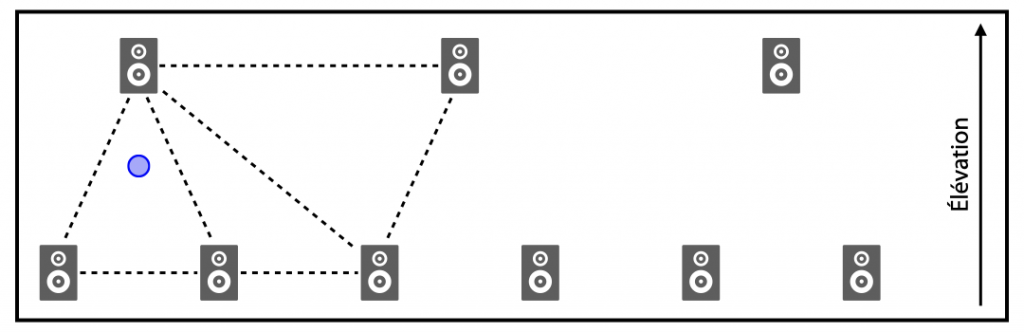
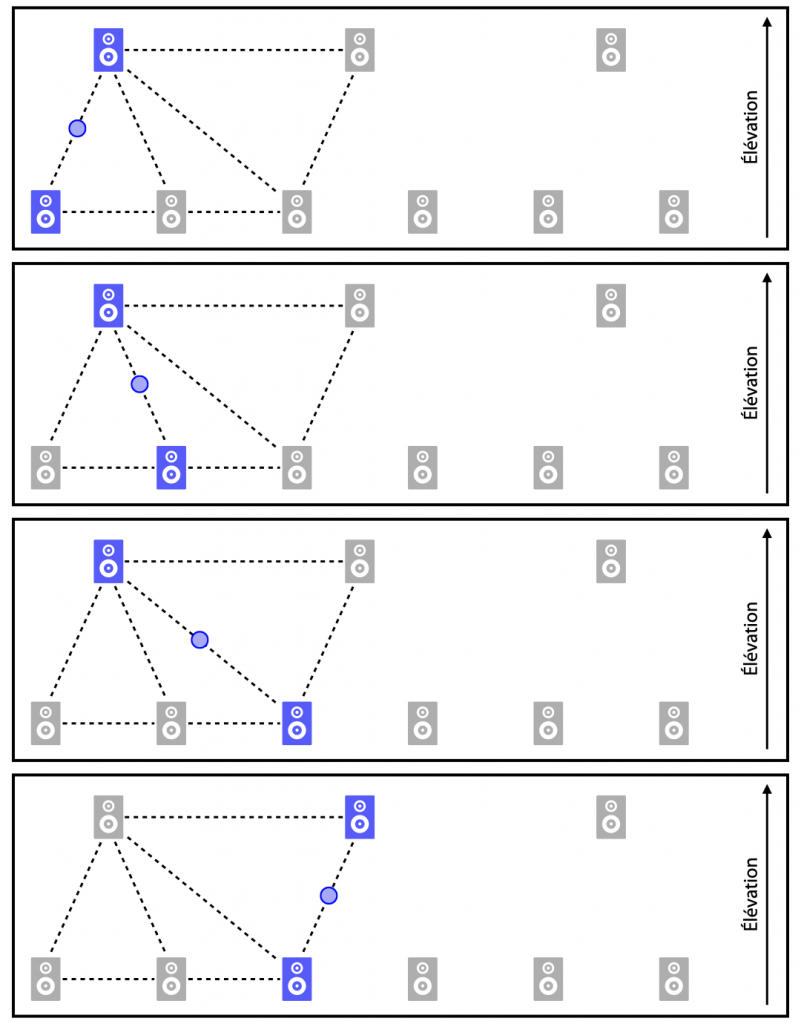
If we break down the movement of a source through this setup (composed of two layers with different loudspeaker densities), we notice that the movement will not be optimal with VBAP. The movement will first be perceived across the three bottom loudspeakers, before transitioning between the two top loudspeakers.
With VBAP, the listener will have the sensation of a sudden bottom-then-top shift:
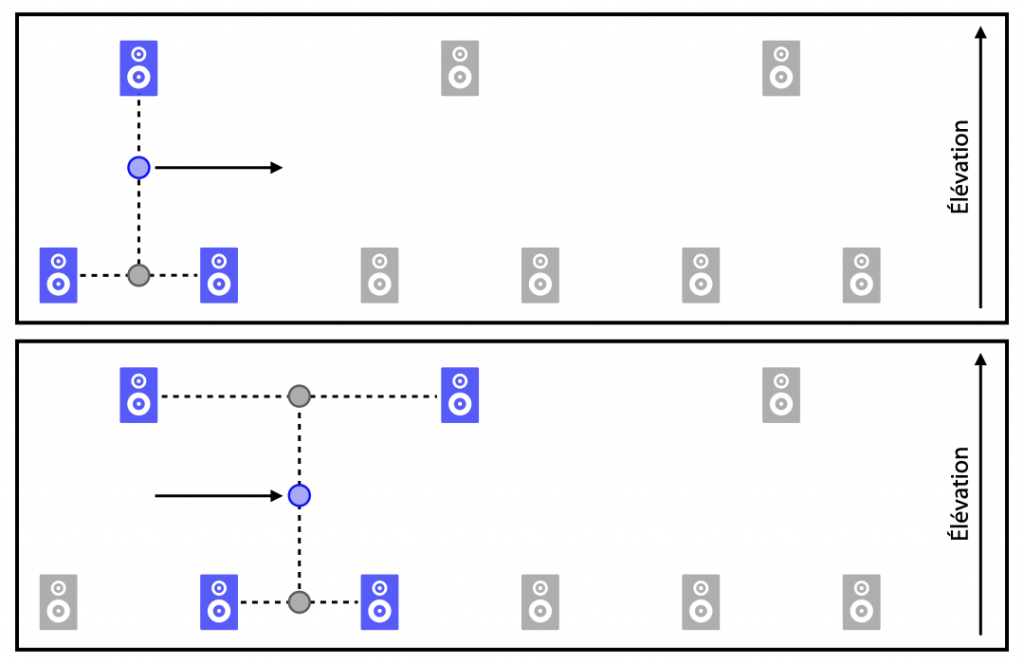
With LBAP, the movement occurs in parallel between the bottom line and the top line, more faithfully reproducing the intended motion:
[1] I. I. Bukvic, “3D Time-Based Aural Data Representation Using D4 Library’s Layer Based Amplitude Panning Algorithm,” Proceedings of the 22nd International Conference on Auditory Display – ICAD, pp. 36-45, 2016.