
VBAP was introduced by Ville Pulkki in the AES journal [1] in 1997. This technique had the advantage — significant for the time — of enabling sound spatialization requiring little computing power, and not requiring a predefined loudspeaker layout as typically imposed by 5.1 surround panning systems.
The name VBAP (Vector-Base Amplitude Panning) means “Amplitude Panning Using a Vector Base”. It refers to the mathematical method used to determine, based on the angular positions of a source and loudspeakers, the gains to apply to each of the loudspeakers that geometrically surround it.
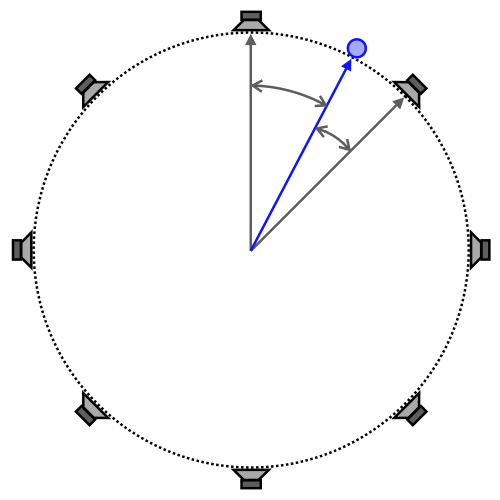
Indeed, to reproduce the image of a source at a point, the algorithm selects a pair (in 2D) or a triplet (in 3D) of loudspeakers surrounding the source. These loudspeakers form with the origin of the coordinate system[2] a vector base used to calculate the gains to apply to the source signal for each loudspeaker.
Consequently, these algorithms only take into account the azimuth and elevation of sources and loudspeakers.
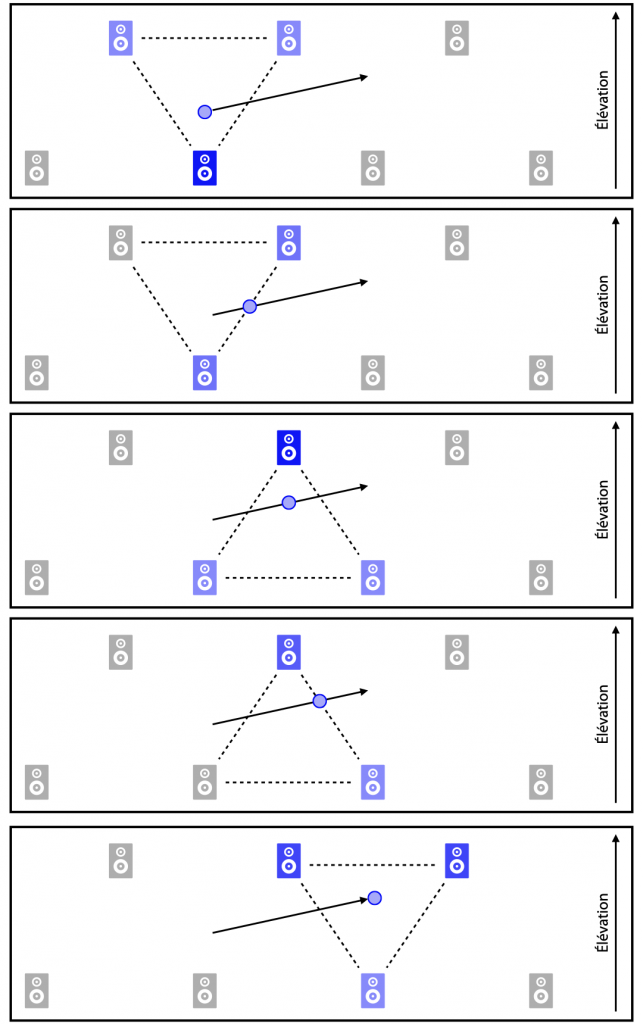
VBAP and VBIP (Vector-Base Intensity Panning) always seek to use the smallest number of loudspeakers possible. Thus, for a source perfectly aligned with the axis of a loudspeaker, only that loudspeaker will be fed the source signal. In 3D, when a source is aligned with the arc between two loudspeakers, only those two will be used. The following figure breaks down the movement of a virtual source in a VBAP bus.
Breaking down the movement of a source traveling through a VBAP (3D) network:
The difference between VBAP and VBIP lies in how gains evolve with the angular position of the source:
- VBAP is based on sound amplitude differences (“A” for “Amplitude Panning”), and was designed to provide precise perception of source position for frequencies below 700 Hz;
- VBIP optimizes this criterion for frequencies above 700 Hz, relying on sound intensity differences (“I” for “Intensity Panning”).
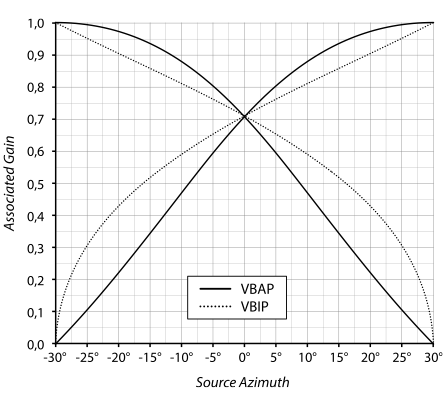
The figure below shows how the gain associated with two loudspeakers (at azimuth -30° and +30° respectively) evolves in VBAP or VBIP as a source moves between these two loudspeakers (in 2D).
[1] Ville Pulkki, “Virtual Sound Source Positioning Using Vector Base Amplitude Panning“, J. Audio Eng. Soc, 45, no 6, 1997, p. 456‑66
[2] At the center of the coordinate system, i.e. position x = 0, y = 0, z = 0.