
Ultimately, the goal is to identify what structures a spatialization system and its interaction with listeners. A simple approach highlights the triplet of emitter, receiver and transmission channel. The emitter consists of sound sources. The receiver is the set of listeners distributed across a listening area. Finally, and not least, the transmission channel consists of a reproduction system (a more or less complex loudspeaker network) and the medium through which sound propagates (air).
This transmission channel, with the ambition of rendering a sound space composed through spatialization or simply reproduced (as we will see later), enables the localization of sources. This means both identifying their direction of emission and appreciating their distance.
By approaching in the simplest way possible the path of information from source to listener, we can highlight what enables a listener to localize a source. This journey will take as its starting point the understanding of what connects emitter and receiver: the transmission channel, and therefore the perceived acoustic wave and the parameters that describe it.
Silence
Silence is an auditory sensation describing the void or absence of sound. It is also a state of equilibrium of the atmospheric medium: without disturbance.
The Acoustic Wave
An acoustic wave is a physical phenomenon corresponding to the propagation of a disturbance through the surrounding atmospheric medium.
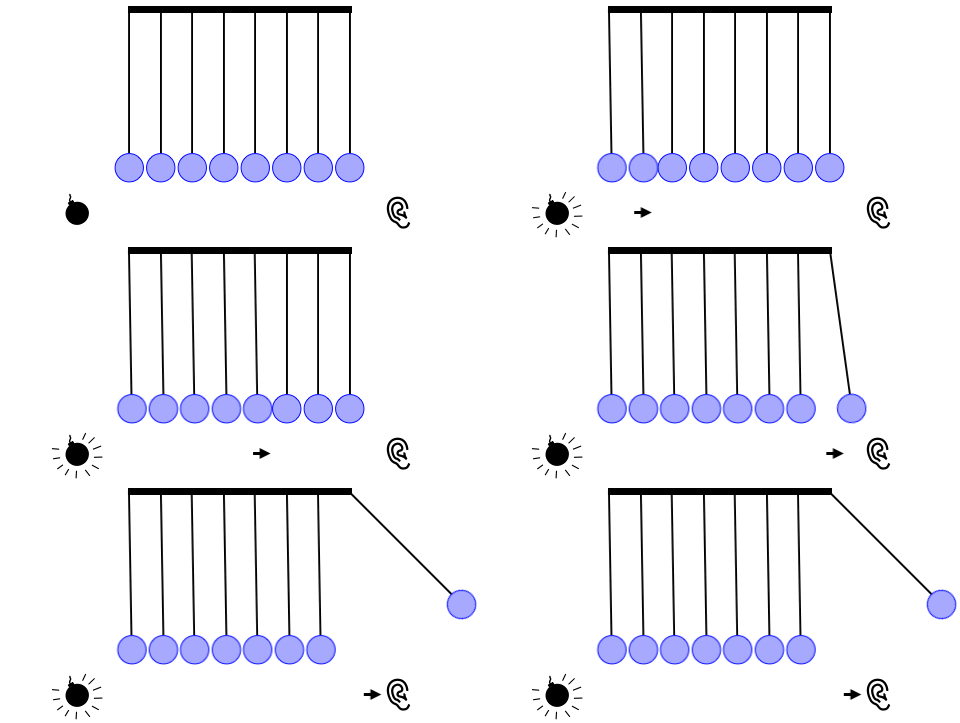
The figure above refers to Newton’s cradle experiment, which illustrates the conservation of momentum in mechanics. An analogy is drawn between the propagation of an inelastic collision between balls and the sequential propagation of an acoustic disturbance. This is a nearly ideal case: there is neither friction nor damping due to elasticity.
In acoustics, this propagation occurs at the speed of sound in air, also known as celerity. It can be approximated by the relation: (csimeq20sqrt{(273.15+T)}) with (T) the temperature in °C. In meters per second, it is (csimeq 340 m/s).
The disturbance manifests itself locally (at a point in space) as a variation over time in pressure. The acoustic wave therefore depends on both time and space.
If time is simply symbolized by the variable (t), space uses several representations through triplets of variables:
- Cartesian coordinates: (x), (y), and (z).
- Angular coordinates: azimuth (a), elevation (e) and distance (d).
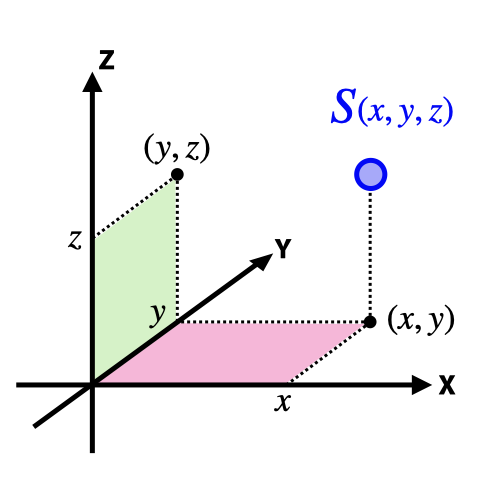
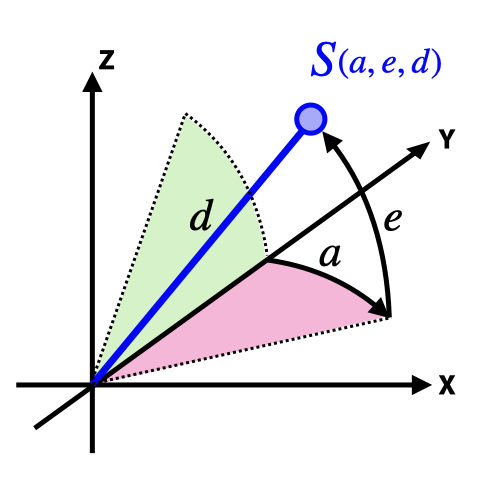
Cartesian coordinates (x,y,z) above and Angular coordinates (a,e,d) below.
The spherical coordinate system (rho,theta,varphi) is not used in spatialization as it is more difficult to conceptualize.
Thus, to understand the physical phenomenon of the acoustic wave, two approaches are used:
- An instantaneous approach. Time t is frozen at a given instant in order to study the acoustic wave spatially.
- A local approach. Space is frozen at a given position in order to study the wave temporally.
Finally, if the propagation medium contains no physical obstacles, the wave can propagate freely — it propagates in free field. Conversely, any obstacle such as a wall or a person’s body will have consequences on its propagation and therefore its perception.