
The directivity of a source and its frequency spectrum
Thus, the higher the frequency F (high-pitched), the smaller the wavelength λ and the more sensitive it is to obstacles of larger dimensions (approximately three times larger). If a high-frequency wave encounters a large wall, it will be reflected in another direction, but also possibly diffused in all directions, or even absorbed.
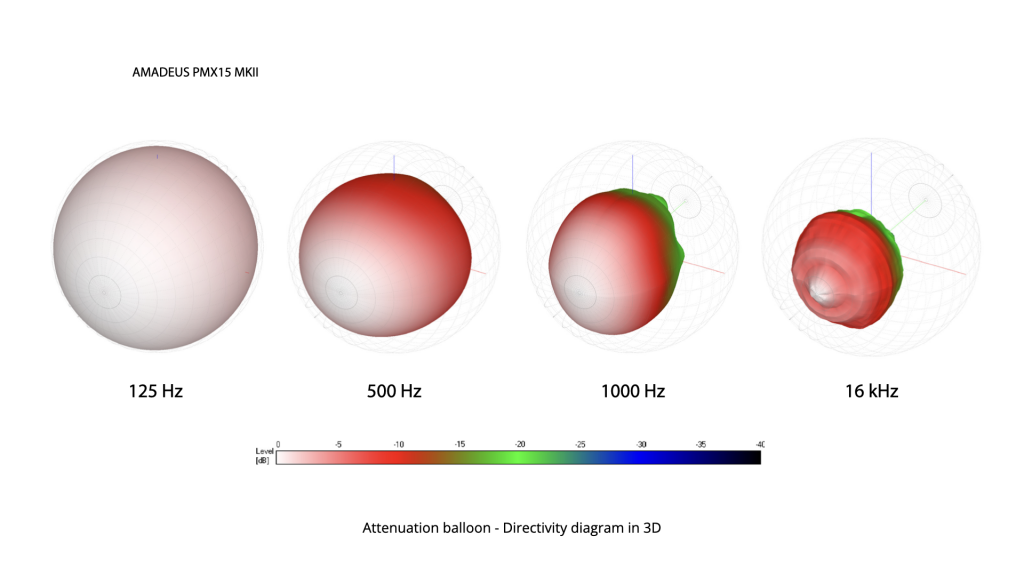
Without going into details of fluid mechanics, an important property of the relationship between wave propagation and frequency manifests itself through its directivity (following figure).
The higher the frequency F (small wavelength), the greater its directivity. Thus, low frequencies (large wavelengths) will propagate in all directions. They will be omnidirectional and more difficult to localize than high frequencies.
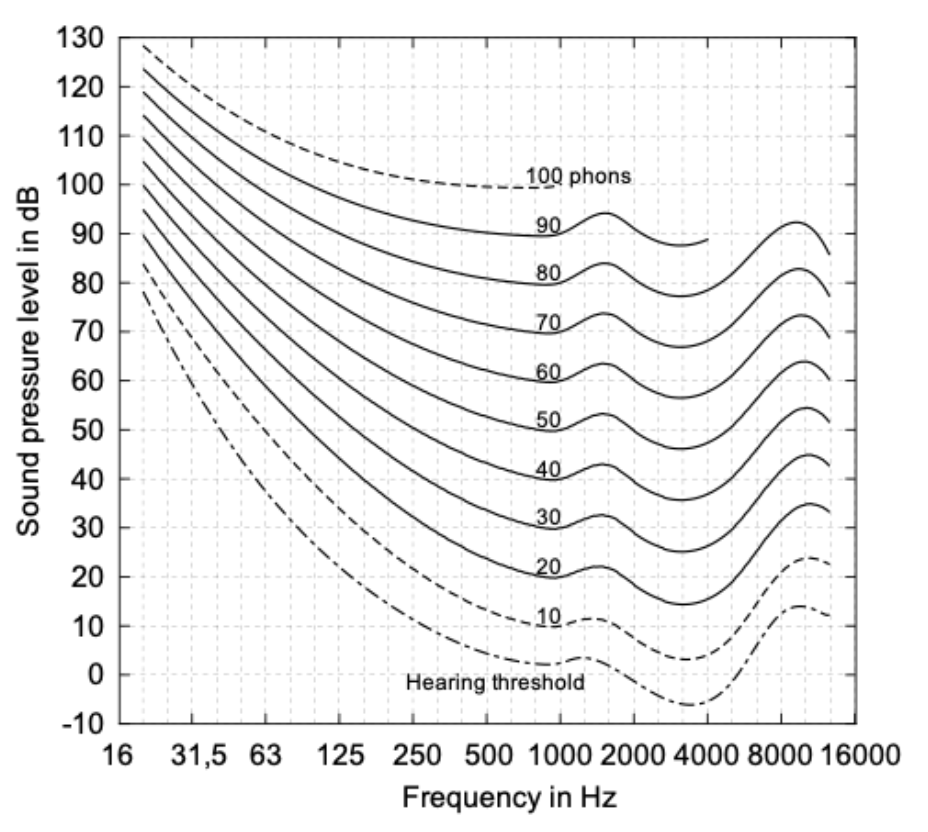
Let us also recall that in addition to this difference in directivity that exists between frequencies in the spectrum of a source, we must also take into account our ability to perceive these frequencies at the same level. Better known as the equal-loudness contours (or isophonic curves) of Munson and Fletcher[1], the figure below gathers the curves of equal loudness sensation as a function of frequency (ELLC, Equal Loudness Level Contour). The phon is the unit used to measure the equal sensation of pure tones relative to a pure 1 kHz signal: for example, all pure tones perceived with the same loudness as a 1 kHz signal at 40 dB SPL will have a level of 40 phons.
In conclusion, considering an acoustic source and its radiation, and then the psychoacoustic conditions for perceiving its spectrum, are prerequisites for understanding localization.
[1] Munson and Fletcher demonstrated in the 1930s that hearing differs according to frequency, and this as a function of the emission level (which itself encompasses the full spectrum). H. Fletcher and W. A. Munson, “Loudness, its definition, measurement and calculation,” Journal of the Acoustical Society of America, pp. 82-108, 1933.