Listen to an audio version (AI) of this lesson in this player:
Challenges
Sound reinforcement systems, unlike lighting for example, are devices that are inserted between the performer and the audience. This intermediary position between creators, performers and spectators immediately establishes fidelity as the primary qualitative criterion.
Sound, and therefore its entire technical and technological chain, is expected to guarantee conformity with the original.
By comparison, light acts by reflection on the performers and the staging. It is therefore accepted by the spectator that a lighting composition is a play of illusions in service of more or less imaginary dramaturgical states.
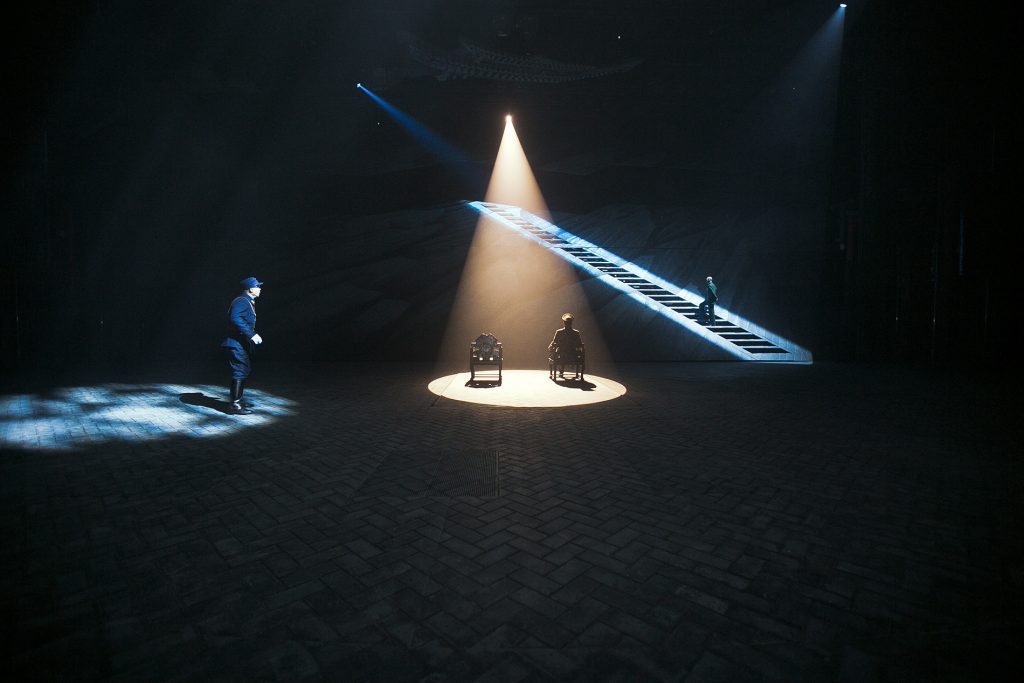
By contrast, due to its intermediary status, the sound reinforcement system must convince and serve as the most realistic possible relay of the performer, and even of a sonic idea. Indeed, just like light, the field of the “sonic” can serve as a relay for an imagination, an idea of sound, a sonic spectacle: the production of an ambient sound that contextualizes, or the diffusion of music that is not performed in situ.
We can therefore conclude that if a sound reinforcement system is faithful and as close as possible to the reality performed before us, then it is capable of convincing us of an imaginary world, a story being told before our eyes.
Thus, spatialization technologies that are based on the reconstruction of a sound field consistent with nature and our perception, combined with the experience and expertise of the sound engineer and creativity, will be able to address all of these challenges.
These challenges had indeed not yet been met by traditional stereo systems, even augmented ones (with the addition of supplementary loudspeakers).
Structure of a Spatialized Sound System
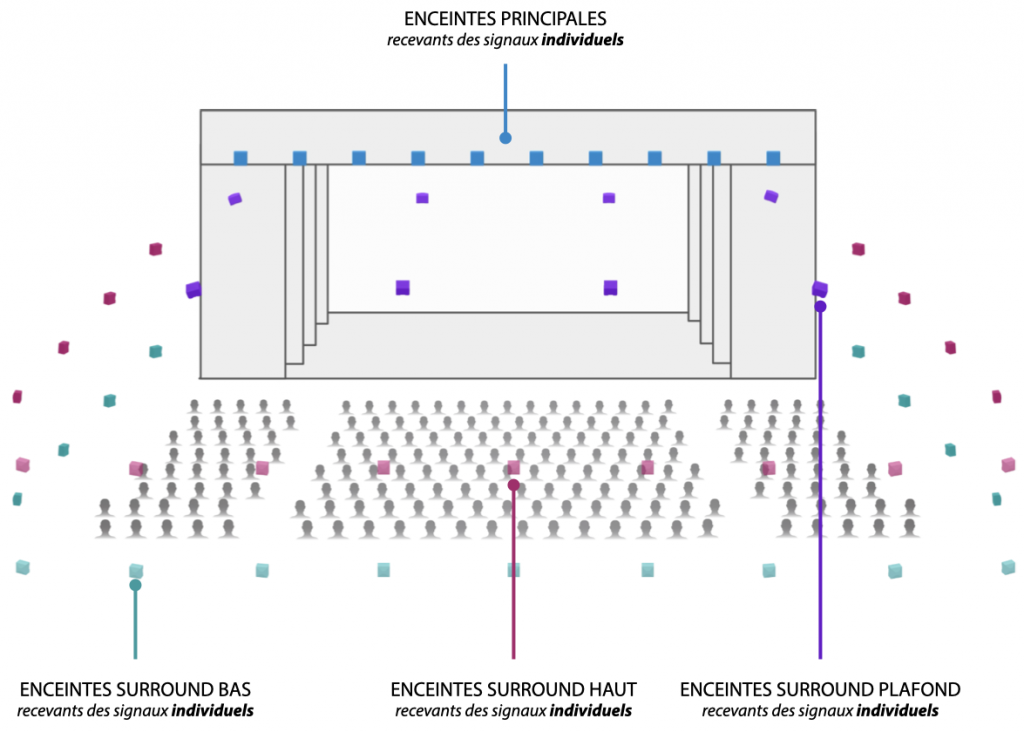
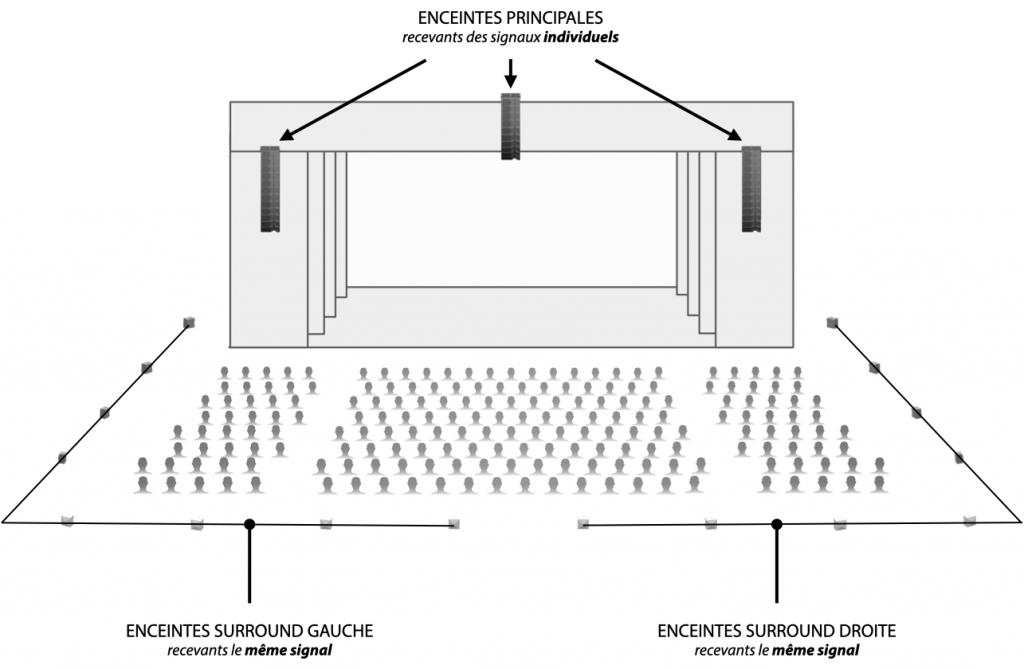
Sound reinforcement systems can be composed of two key elements: front loudspeakers, for sounds coming from the stage (which in particular ensure visual and auditory correspondence), and surround loudspeakers, for immersive purposes (which most often contextualize the frontal perception).
“Surround” loudspeakers surround the listening area in order to provide sonic immersion. They are also referred to as immersive loudspeakers.
With traditional systems, panning sounds from left to right is done from the mixing console, which provides the audio channels destined for the distribution processors and amplifiers.
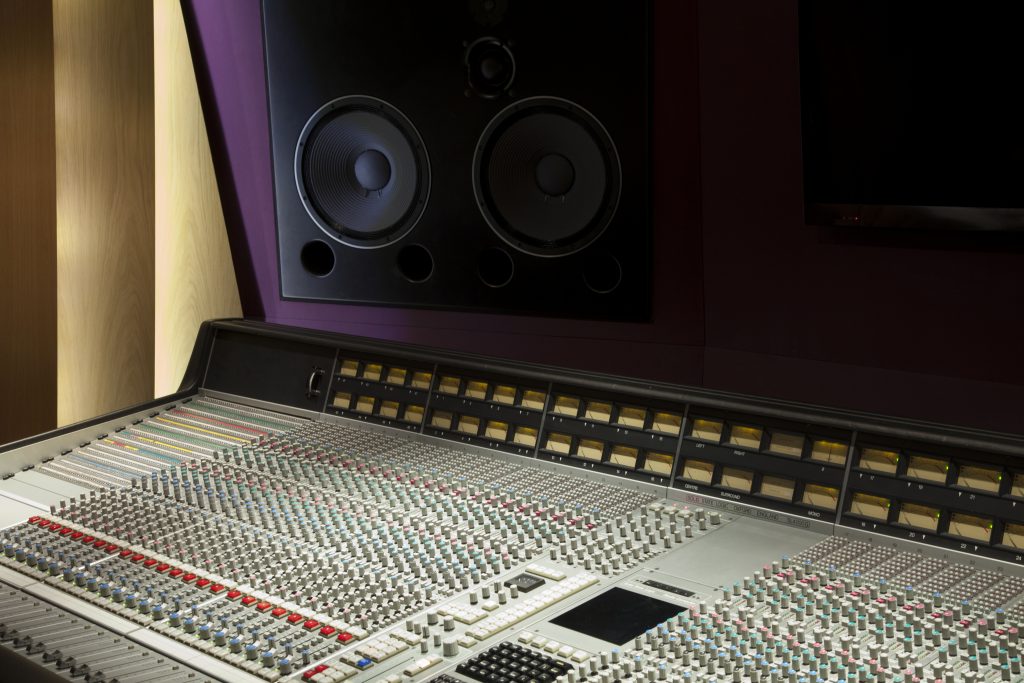
In sound spatialization, the calculation of signals destined for each loudspeaker is performed individually by an external audio processor (such as HOLOPHONIX) using complex algorithms. It is controlled via a user interface that allows a precise localization of sounds to be defined. The processor is integrated between the mixing console and the distribution processors.
Processors provide frequency and time correction of the loudspeakers upstream of the amplifiers to ensure sonic homogeneity regardless of their positions in the acoustic space where they are used.
Front System
A traditional “front” stereo system consists of left and right “main” loudspeakers, sometimes with an additional center loudspeaker (LR and LCR systems illustrated by the photo and the following figure).
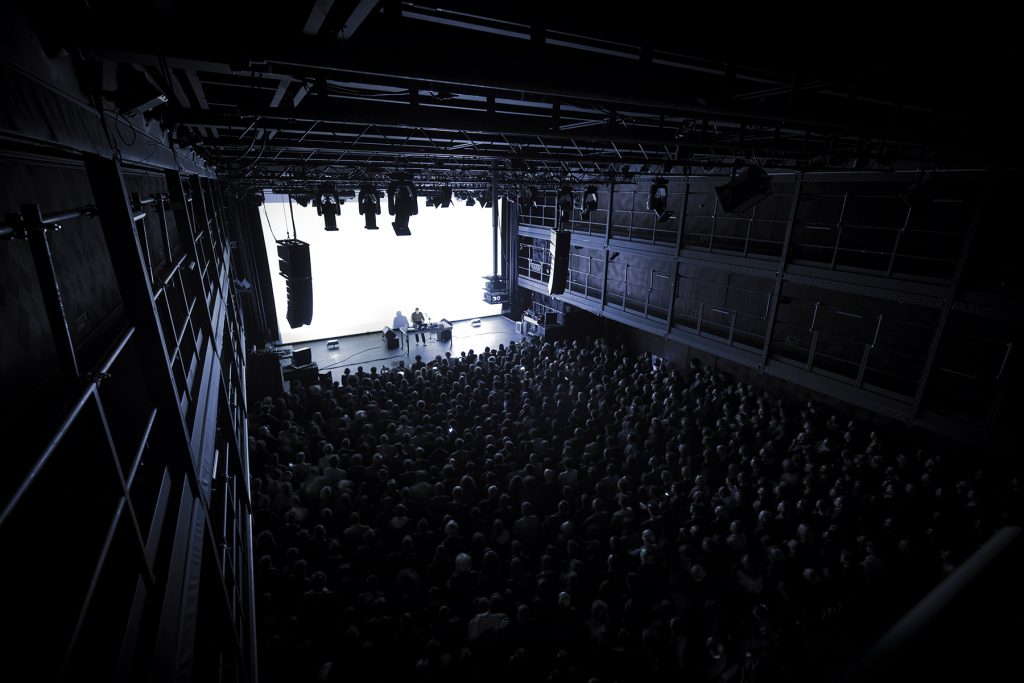
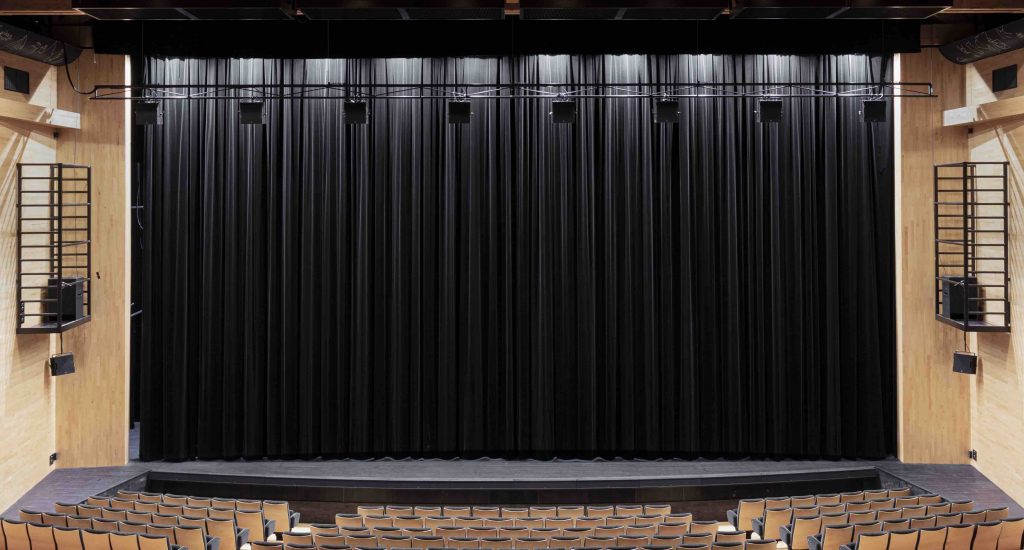
Spatialization front systems, on the other hand, rely on multiple loudspeakers (generally between 8 and 12) distributed across the entire width of the front, for frontal reinforcement.
Just as with traditional systems, complementary sub-systems such as front-fills at the stage edge and delays can be added.
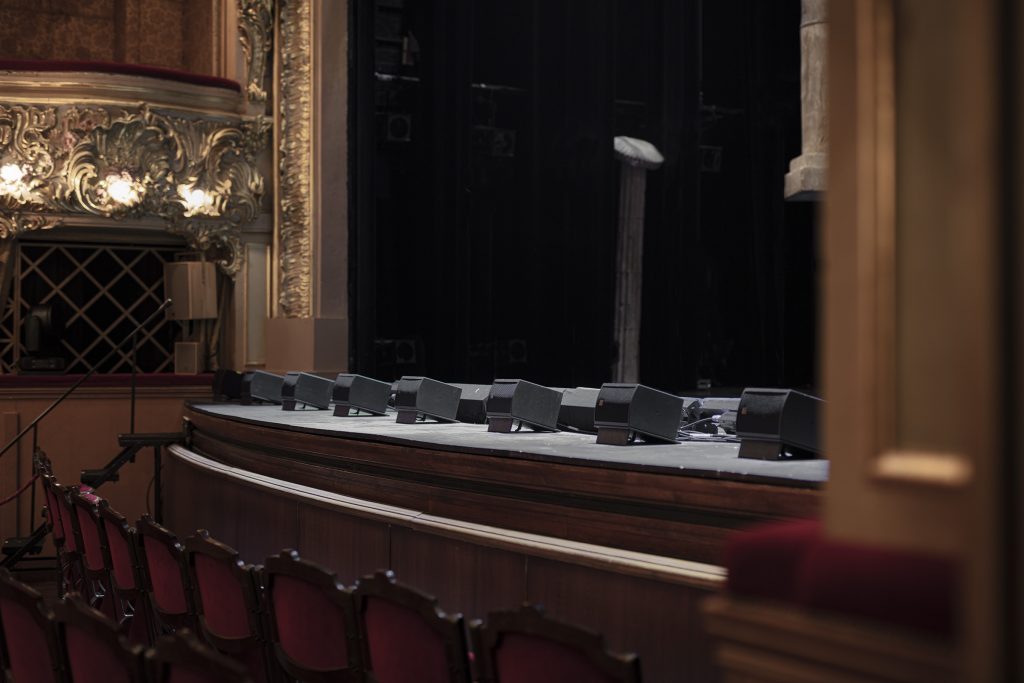
“Front fill” loudspeakers are distributed at the front of the stage. They are intended for audience members closest to the artists who are excluded from the coverage of the main system (FOH, Front Of House).
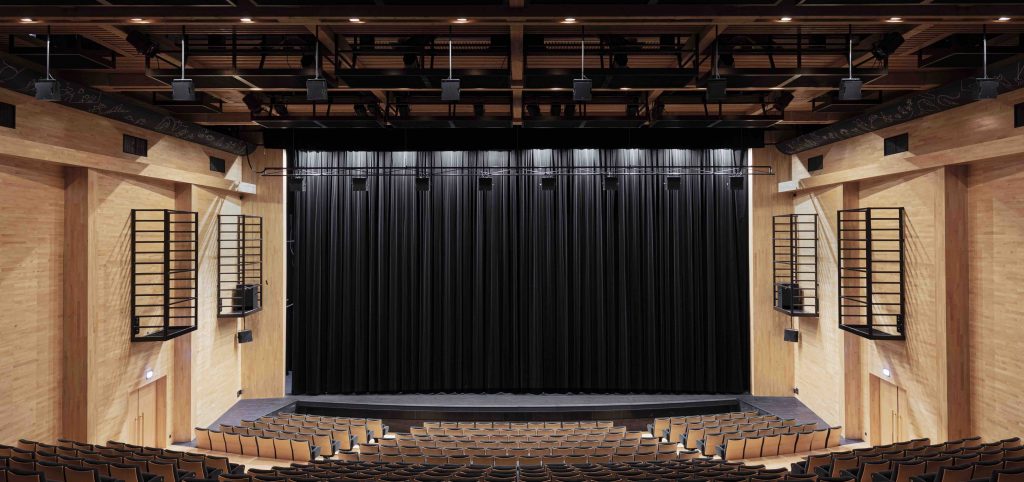
Immersive System
In immersive spatialization systems, the loudspeaker array is distributed at the periphery of the listening area (surround). Each loudspeaker receives an individual audio signal, thus offering more precise localization as well as more flexible configuration possibilities. For certain configurations, it is also possible to work with elevation (following figure).