
In general, the reproduction of reality by a technology is never perfect.
In the case of a line array, for example, the production of a sound wave is assumed to be cylindrical, thus offering an attenuation of acoustic intensity[1] inversely proportional to distance — unlike a spherical wave (closer to reality) which is inversely proportional to the square of the distance. This property allows sound to be projected with low attenuation over greater distances. However, the requirements for reproducing this cylindrical wave cover a set of 5 theoretical criteria: WST[2]. The difficulty of implementation results in spatially heterogeneous spectral coverage beyond a certain frequency, linked in particular to the spacing between elements of the line.
In the case of WFS, the inter-acoustic spacing, similarly, will have the effect of producing “spatial aliasing” — that is, a spectrally heterogeneous definition or resolution that varies spatially depending on the listening position. In theory, the inter-acoustic spacing should approach zero and the line should have infinite length.
HOLOPHONIX offers control over a number of parameters in order to adjust wavefront reconstruction according to the limitations that may arise.
Remarks, Limitations and Solutions
“Full delay” and “Minimal delay”
By default, the goal of WFS is to reconstruct a secondary spherical wavefront identical to the original, taking into account the distance from the source to the line. Depending on this distance, this delay can be significant ((simeq 3ms/m)). This is especially relevant for a virtual source that does not physically exist and does not actually radiate behind the line.
Spatialization, and therefore the authoring of sonic space, may lead sound designers to virtually move this type of source to large distances, inducing a delay that impacts the overall mix. To address this, it is possible to subtract the minimum delay related to the distance between the source and the nearest loudspeaker (“minimal delay” mode).
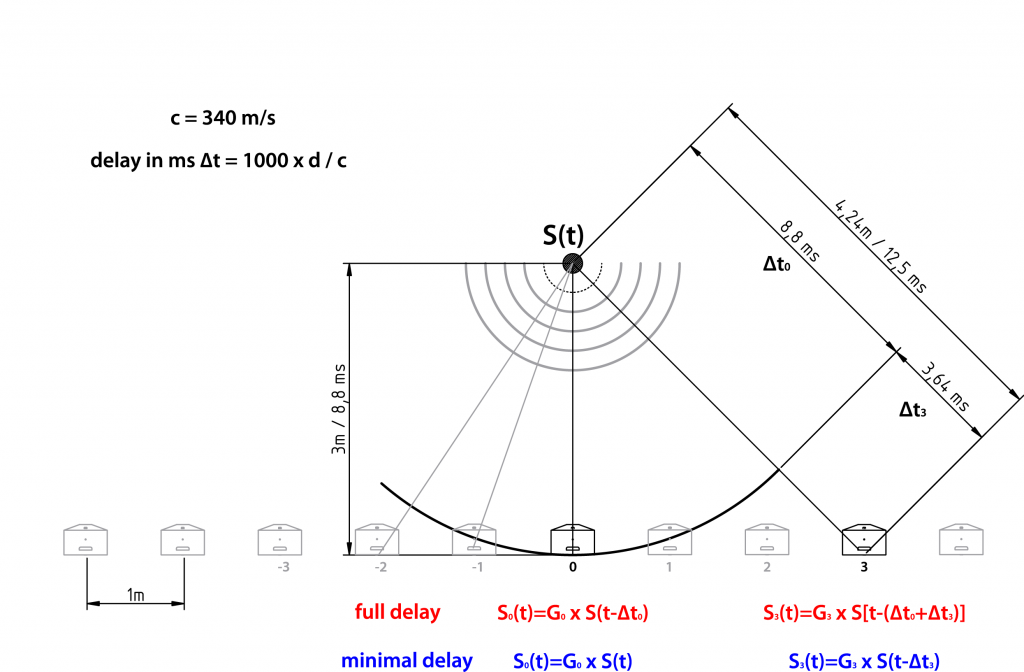
Delay variation
The direct consequence of moving a source behind the line is a variation in the delay specific to each loudspeaker.
The delay variation is directly linked to the speed of source movement. It will affect the source signal, which will be pitch-shifted downward or upward during this variation. This is a phenomenon analogous to the Doppler effect.
If the delay increases, the sound will be transposed downward, and conversely upward if it decreases. This effect only lasts for the duration of the variation, and therefore the time required for the movement given its speed. If the source does not move too quickly, the effect will be almost imperceptible.
Edge effects at the line boundaries: truncation of the secondary wavefront
As described previously, the WFS line is assumed to be of infinite length. In practice, implementation involves a constrained length, determined essentially by the dimensions of a stage frame, for example. At the ends of the line, the secondary wavefront cannot be coherently reconstructed since there are no more loudspeakers to reconstruct it. This abrupt truncation causes a wave diffraction effect.
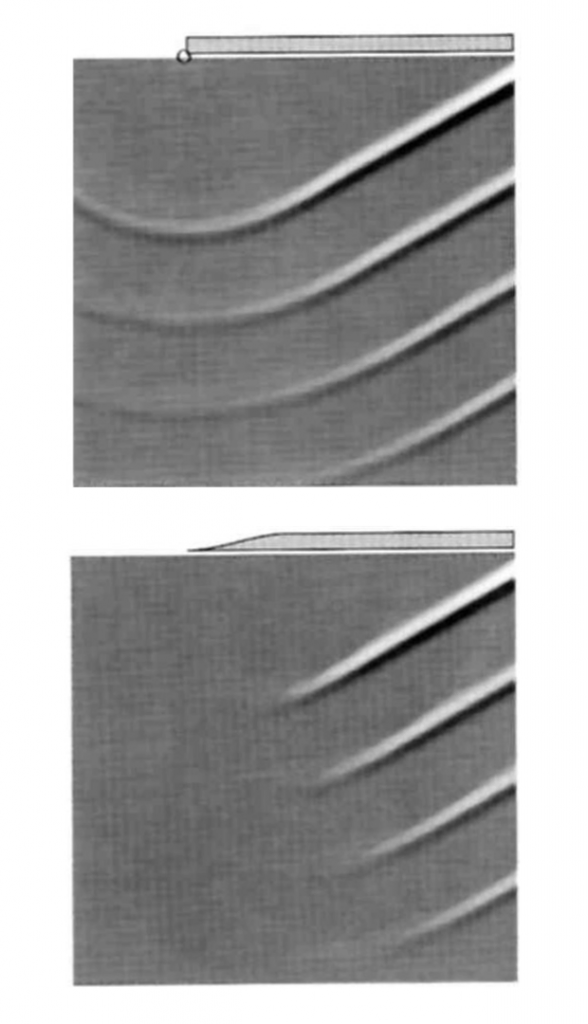
A gradual attenuation at the extremities avoids this diffraction effect (figure above): windowing. In practice, if the coverage area of the sound system extends beyond those extremities, this windowing will be limited or inactive in order to cover extreme zones. It is accepted that these extreme zones outside the effective range of the line will not benefit from WFS reconstruction, but only from near-mono reproduction. This is the trade-off required to guarantee the widest possible sound coverage. HOLOPHONIX provides fine control over the size of this window (“windowing”). The window size is adjustable between 0 and 100% via the advanced parameters of a WFS bus. By default, 30% of the maximum possible size is applied.
Minimum listener distance: the critical distance.
While it is fairly natural, as a listener, to position oneself at a comfortable distance from a loudspeaker, it is established for a WFS loudspeaker array that a listener close to the line must perceive the contribution of at least three loudspeakers. This minimum distance is called the critical distance (D_{critical}).
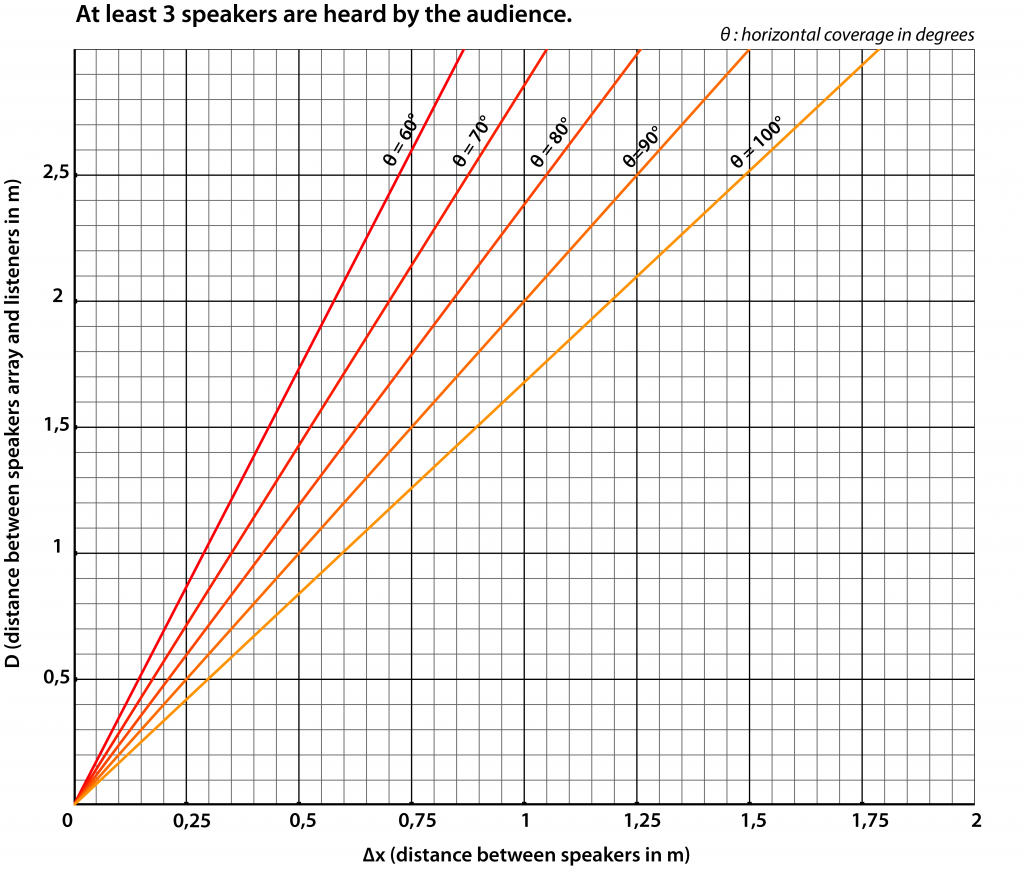
Advantages:
- Precise localization over a wide area of the audience.
- The source is perceived and localized beyond the loudspeaker array.
- Provides a strong sense of distance and realism.
- Source localization is independent of listener position.
Disadvantages:
- Requires a high spatial density of loudspeakers to avoid “aliasing”. This generally depends primarily on the proximity of the audience.
- Can produce comb filtering at high frequencies.
- Can produce artifacts similar to the Doppler effect when sources move rapidly (in “vdelay” mode).
- Can produce comb filtering (in “xdelay” mode).
[1] Acoustic intensity is the acoustic power dissipated through a surface.
[2] Wave Sculpture Technology is based on an optical approach to Fresnel arrays to construct a controlled cylindrical wavefront. M. Urban, C. Heil and P. Bauman, “Wavefront Sculpture Technology,” AES Journal, 2003.