
Ambisonics is an immersive acoustic field reproduction technique (centripetal). It is also a technology for recording the acoustic field. It was developed by Michael Gerzon at the University of Oxford in the 1970s. Its implementation resulted from close collaboration with Peter Craven (Calrec). Still an active subject of study and research, Ambisonics very quickly found commercial applications aimed at the general public. Because its implementation is all-encompassing with a less dense loudspeaker network than WFS, this technique is increasingly exploited for sonic immersion.
Encoding and Decoding
Ambisonics is realized in two stages: encoding and decoding. It is based on dividing space into subdivisions called spherical harmonics. The encoding process corresponds to generating contribution signals for each subdivision (each harmonic) of a virtual source. These signals form an Ambisonic stream (multichannel). As an analogy, there are as many signals as there are dimensions used as coordinates to identify points in space. Space is generally described by the 3 dimensions ((x,y,z)) of a Cartesian coordinate system. In the case of Ambisonics, it is described by a larger number of dimensions (spherical harmonics). Ultimately, this stream is then decoded in order to provide signals to the loudspeakers.
Another way to conceptualize the process is that of a spatial sampling: the finer the sampling (high resolution, high order), the more precisely and faithfully it can be reconstructed.
This process gives Ambisonics great flexibility, as an encoded stream can be decoded to a wide variety of loudspeaker layouts. With HOLOPHONIX, this encoding and decoding process is fully integrated. You can use Ambisonics to spatialize virtual sources, but also to decode streams created in different encoding formats, or streams coming directly from Ambisonic microphones.
Analogy with the MS Microphone
The principle underlying Ambisonic encoding and decoding is very similar to M/S recordings, which could be considered as one-dimensional Ambisonics.
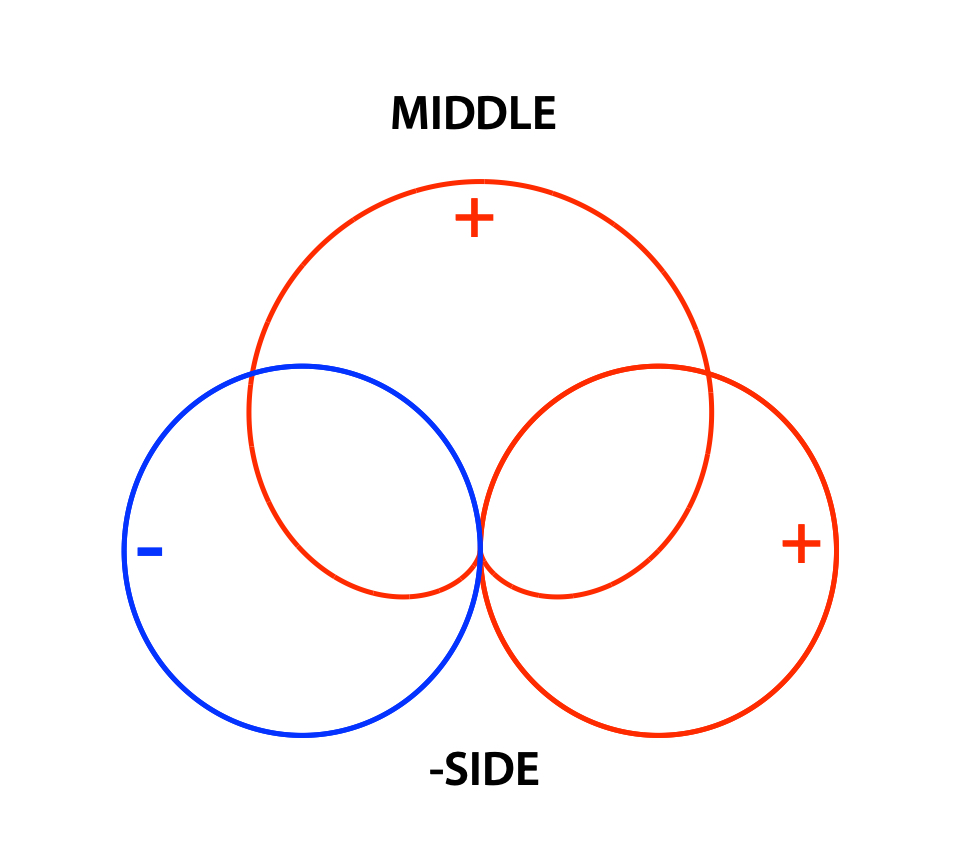
The MS pair allows recording stereophonic scenes, but does not rely on a conventional microphone pair. It uses both a cardioid microphone to record the middle (M for middle) of the scene and a bidirectional microphone to record the left and right sides (S for side). These are coincident.
Recordings produced by this technique are not meant to be played back directly on loudspeakers. The signals must first be decoded for playback on a stereo system.
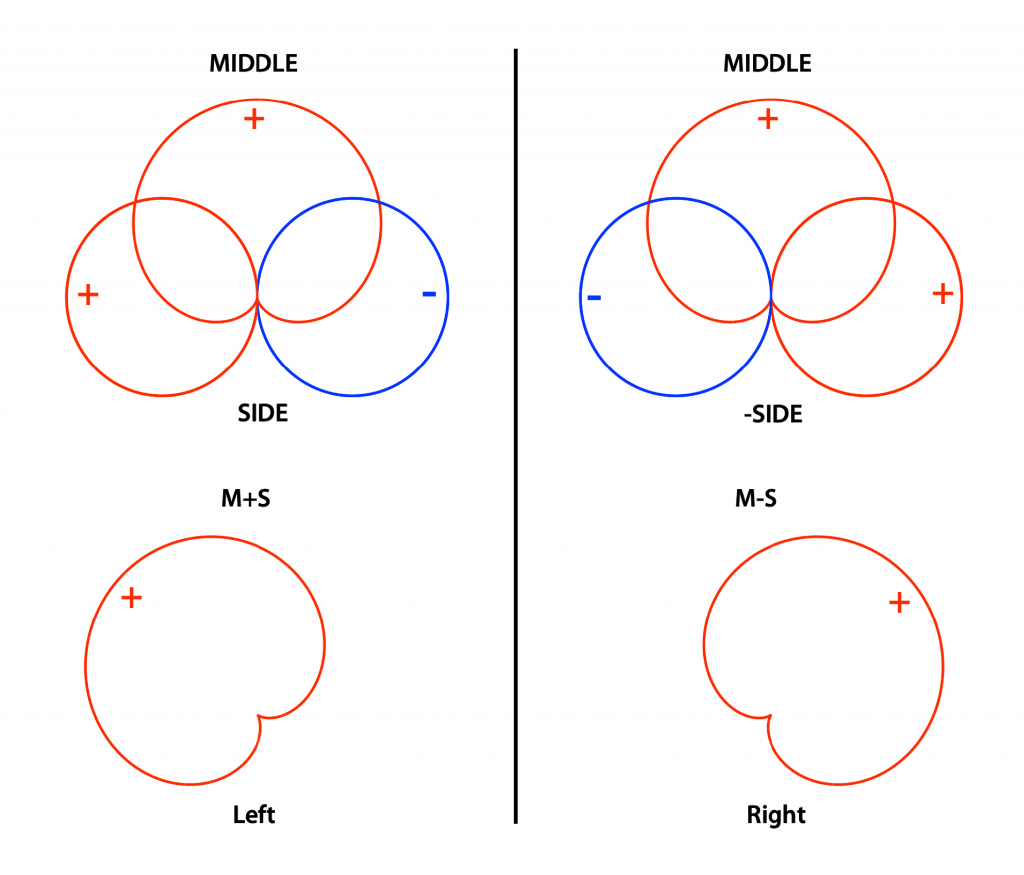
The decoding process therefore consists of matrixing the directivity components (figure above), for a given loudspeaker layout such as stereophony:
- the left channel signal is obtained by adding the M and S channels: the out-of-phase lobe of S will cancel the right portion of the M signal.
- the right channel is obtained by adding the M and -S channels. -S has its phase and therefore its directivity inverted. The out-of-phase lobe will now be the left lobe, which will cancel the left portion of the middle signal.
First-Order Ambisonics (2D)
Ambisonics works on the same principle. In 2D, instead of a cardioid Middle M channel, there is an omnidirectional component called W. The equivalent of the S side channel is called Y, and an X channel, bidirectional, covers the front and rear zones.
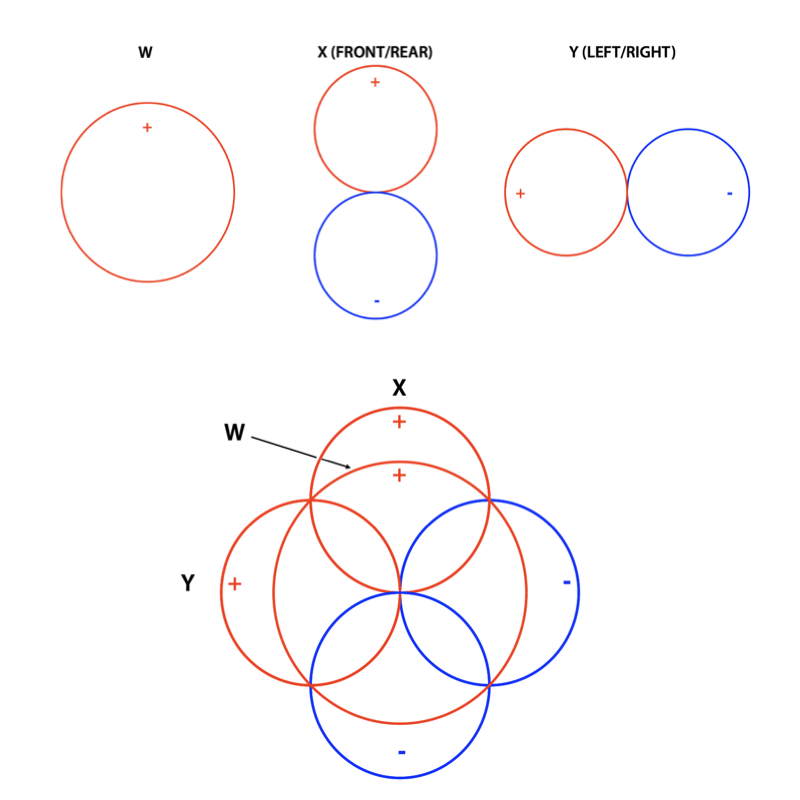
This 2D stream can then be decoded for a loudspeaker arrangement containing at least three or four loudspeakers surrounding the listener (the distribution should be as homogeneous as possible in order to cover the listening area).
The immense advantage of Ambisonics lies in the fact that the decoding of a loudspeaker’s signal can be done regardless of its position (within reasonable limits of course), thus offering great flexibility in loudspeaker placement.