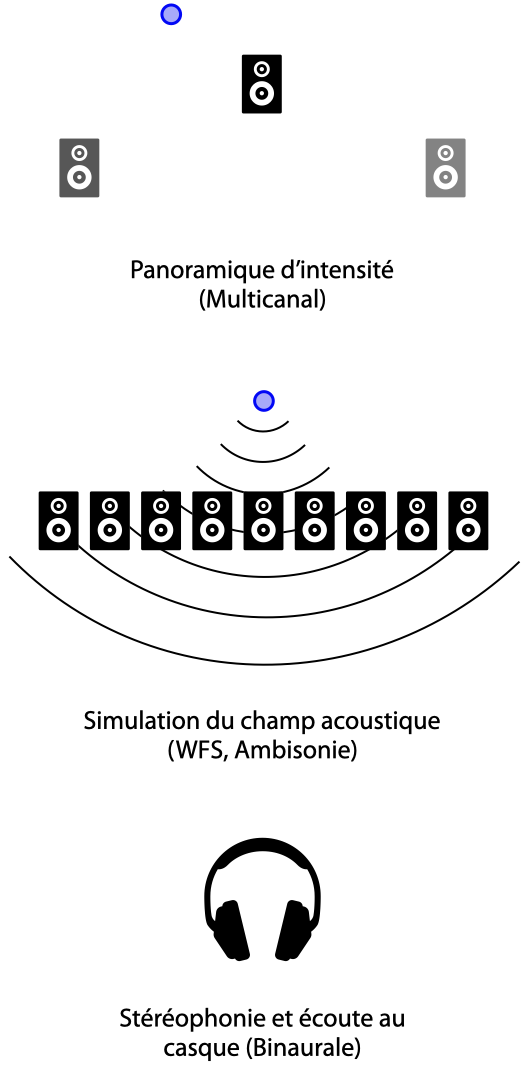
Limitations of Stereo Systems in Sound Reinforcement
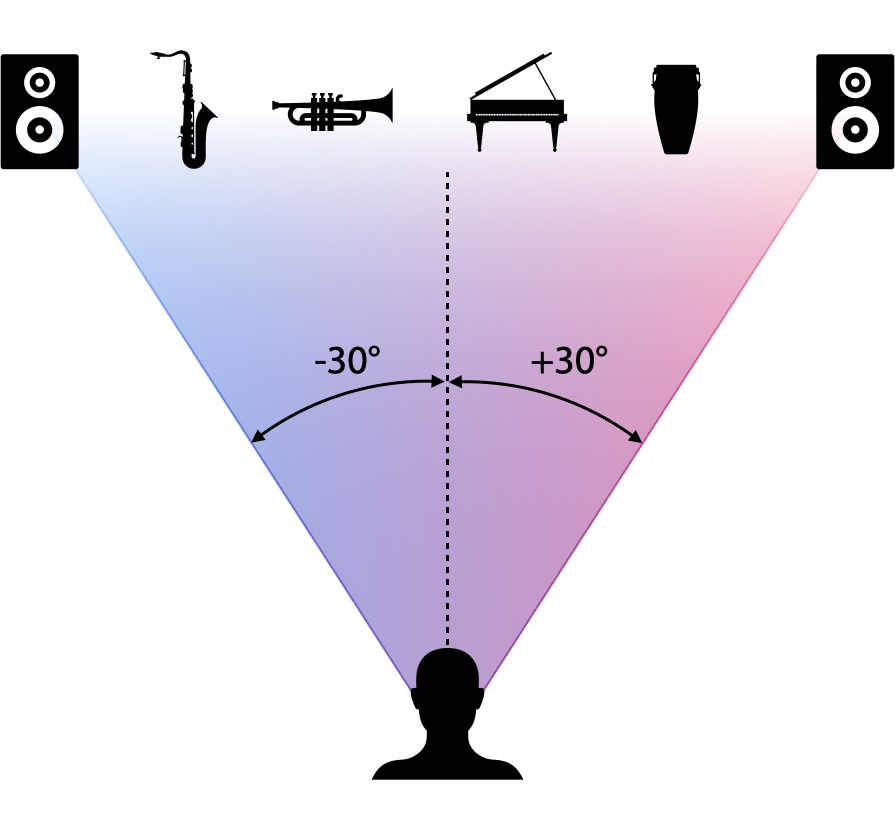
Stereophony is a multi-channel reproduction system using 2 channels (left and right).
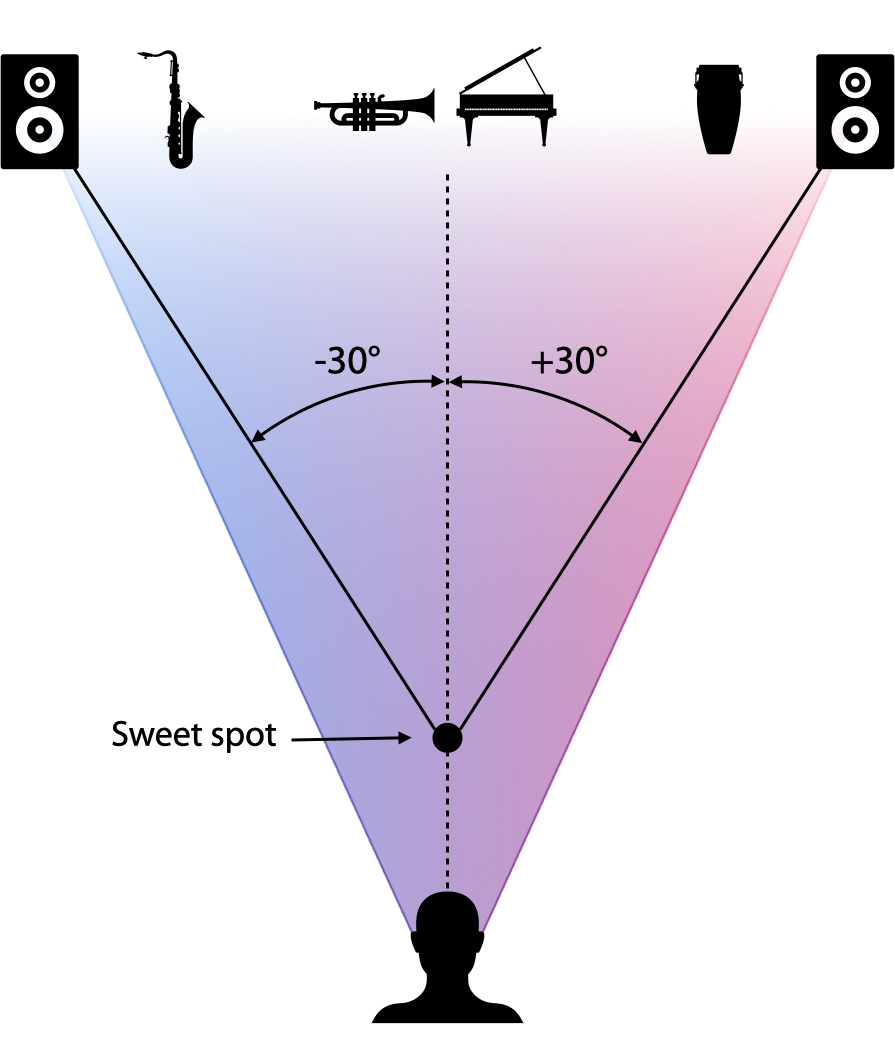
Each channel favours one ear such that, in the case of loudspeakers, they are equidistant from the listener and separated by an angle of 60° relative to the listener.
It is a “de facto” standard offering the best compromise in the majority of situations and a technical reference.
The loudspeaker–listener triplet forms an equilateral triangle, and the listener’s position is called the “sweet spot”.
The sweet spot is the ideal listening position associated with a diffusion system.
Under these conditions, the difference in send level (called panning) of a signal into each of the loudspeakers produces the illusion of a sound source positioned between them (a phantom image).
A sound scene can be faithfully reproduced like a photographic image.
Sweet-spot: The Weak Point of Stereo
Consequently, the localization of sounds (distribution of so-called phantom sources between the left and right loudspeakers) in stereo systems is only valid when listeners are seated at the centre of the audience (at the sweet spot); a major drawback (following figure).
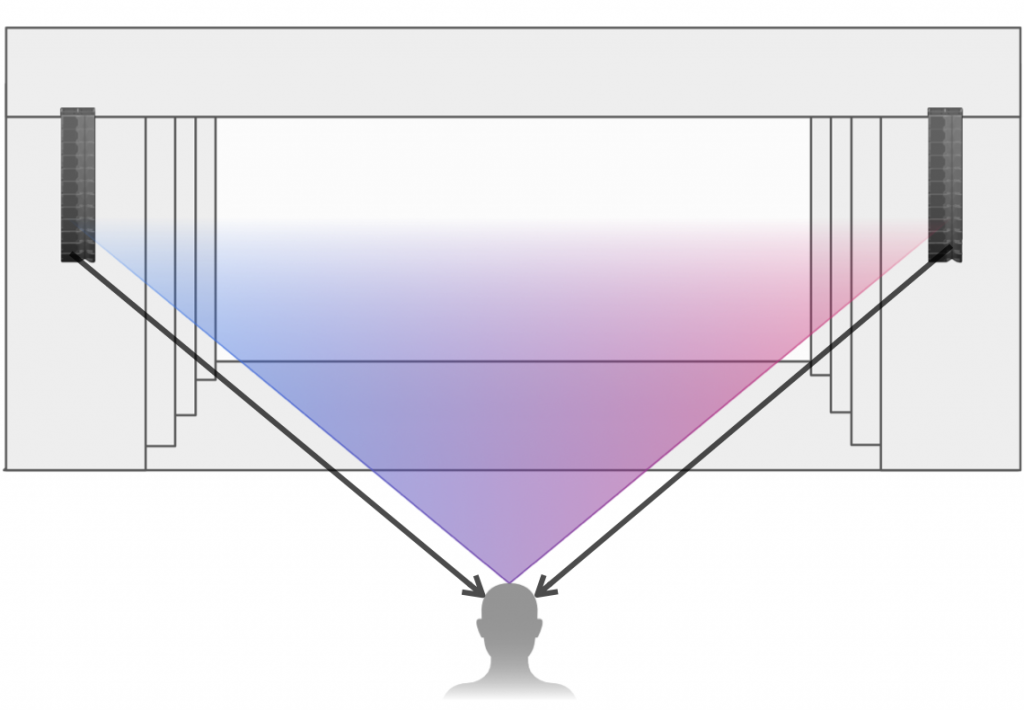
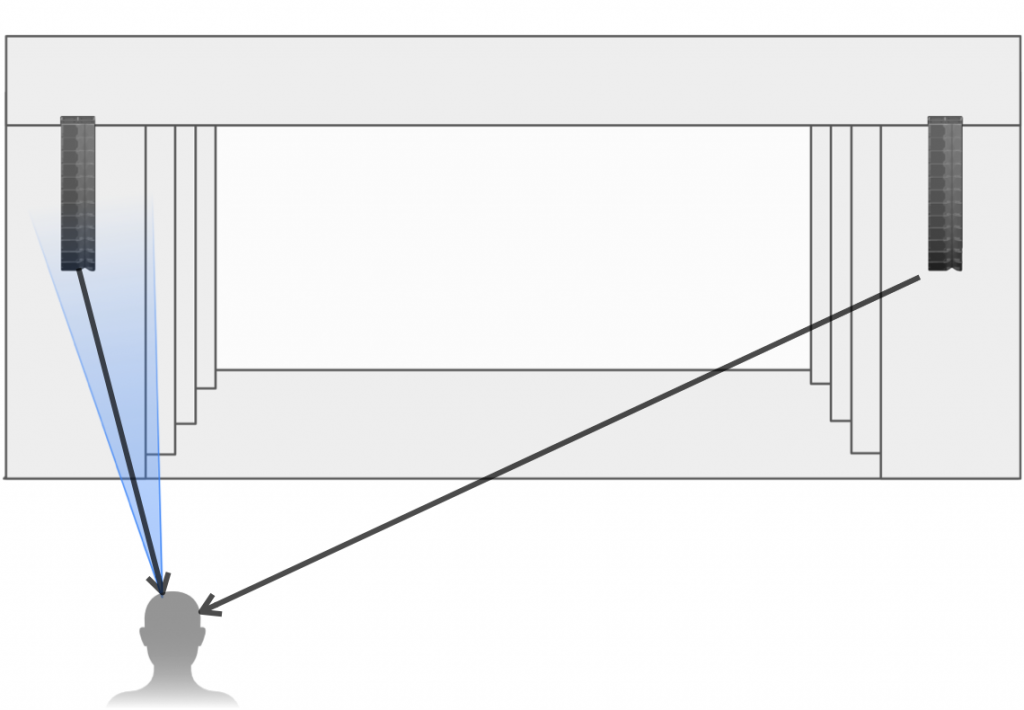
Unfortunately, if these conditions are not met, the sound scene will at best be distorted (the listener stays at centre but moves forward or backward moderately) and at worst truncated and concentrated on one of the two loudspeakers (the one closest to the listener, by the precedence effect, when the listener moves off the central axis).
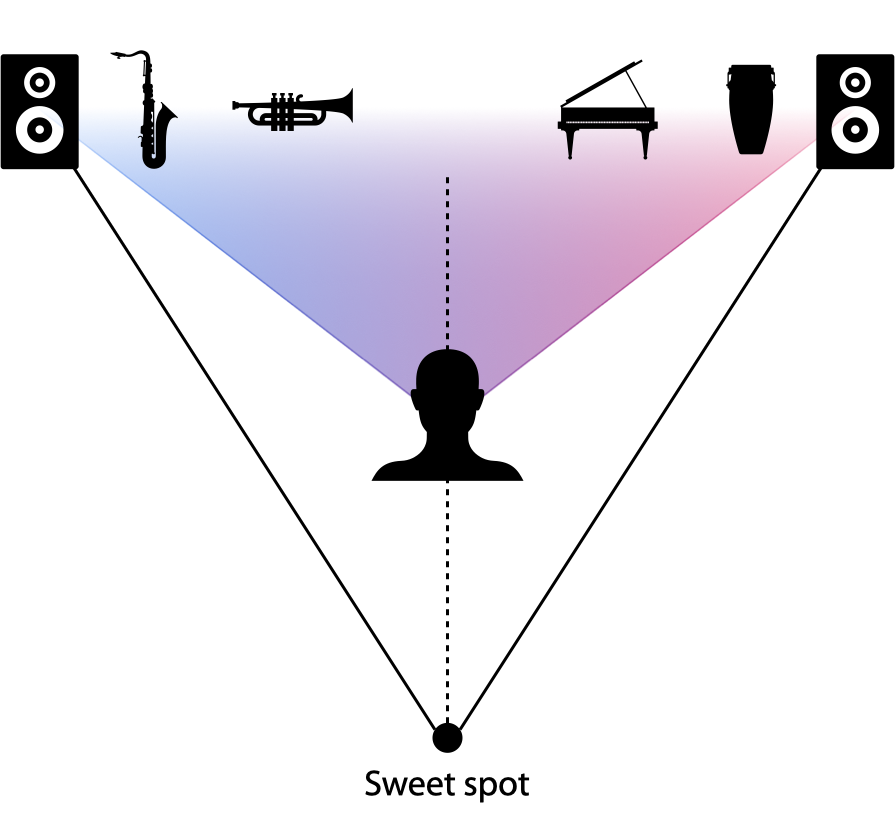
On the scale of a concert hall, only a few seats will meet optimal conditions: an all-or-nothing law identifying the good and bad seats.
When Stereo Ends Up Being… Mono
Faced with constraints that are too restrictive, sound engineers — who must guarantee fairness between all audience members on one hand, and respect the artistic intent on the other — are often led to send signals at nearly the same levels to both loudspeakers: centred sources, a near-mono mix on each loudspeaker.
In practice, it is possible to add a centre loudspeaker and/or a network of front-fill loudspeakers at the edge of the stage in order to moderately (re)lateralize sources in the main stereo mix and cover areas of the audience that were previously excluded.
But these additional diffusion circuits remain mono summing in the majority of situations.
Consequences of the “Frequency Masking” Phenomenon
Ultimately, this strong convergence towards mono mixing is not without consequences for the blending of signals with common frequency bands that are likely to mask each other from the listener’s perspective.
This psychoacoustic phenomenon is called frequency masking.
To remedy this, filtering and dynamic processing (compressors, etc.) can lead to radical modifications of the original sounds in order to guarantee that the same information is perceived by everyone, regardless of their position in the venue.
The information is preserved, but its credibility or perceptual realism is very largely called into question.
Perceptual equity is in contradiction with reproduction fidelity.
The Advantages of Spatialization
Spatial sound reinforcement offers several advantages, depending on the technique used.
Visual Correlation
Sound spatialization enables strong audiovisual correlation. With traditional sound reinforcement systems, it is not possible to reproduce a localization — a precise origin of sounds — unless the listeners are at the centre of the venue. As a result, the audience perceives the sound from the performer in the direction of the nearest loudspeaker, with a major delocalization effect. Spatialization algorithms and acoustic field reproduction techniques such as Wave Field Synthesis (WFS) allow every listener to perceive the sound as coming from the correct direction: the position of the performer. Acoustic field reproduction contributes to listening comfort: audience members are more focused on the artistic content of the performance, less fatigued, and less distracted.
Artistic Possibilities
Such a system offers many creative possibilities, enabling performances to deliver a much more compelling, tangible, and immersive experience.
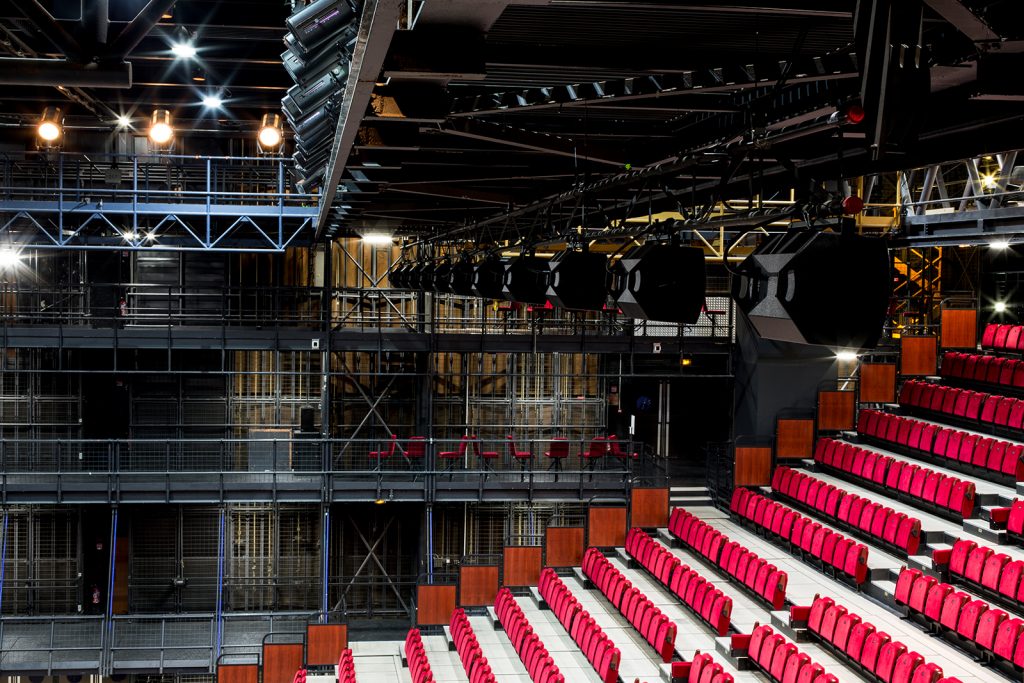
The main loudspeakers distributed above the stage enable precise and credible localization of sounds, while the outer loudspeakers at the extremities of the main line extend the sound scene. This extended coverage allows sounds to be projected off stage and adds a stronger sense of immersion, even without surround loudspeakers.
Finally, the use of surround loudspeakers at the sides, rear and ceiling of venues creates a truly immersive environment: a realistic extension of the sound scene in three dimensions.
Improved Audio Experience
Thanks to the fundamental characteristics of their algorithms, and unlike traditional stereo systems, spatialization systems improve reproduction quality while homogeneously extending the listening zone:
- Reduction of frequency masking caused by summing signals with shared spectral content on one or two channels (in mono or stereo). Spatialization (controlled distribution of sound over a greater number of channels) reduces the need for correction tools such as equalization or compression.
- Almost all listeners localize sounds at their intended positions. The sound scene is virtually identical for everyone, regardless of listening position. The artistic message is almost no longer altered by one’s position in the venue, unlike stereo systems which only favour the central zone of a concert hall.
Reproducing the Acoustic Field: The Solution, the Comfort, a Creative Tool
Rather than projecting a mix of multiple sound sources onto a sometimes very limited and constrained number of loudspeakers (near-mono), are we able to reproduce each of these sources as if they were naturally radiating?
Can we imagine (re)producing a non-existent (phantom) sound source on stage or in the venue, as if it were radiating in front of, around, or alongside us?
Today, it is possible to free ourselves from the previously mentioned constraints through multi-channel projection technologies on the one hand, and acoustic field reconstruction on the other (WFS and Ambisonics).
Moreover, if it is now possible to reconstruct acoustic waves nearly identical to those emitted by sources (WFS), then an entire surrounding acoustic field (Ambisonics) — as our brain knows it — can be composed, almost independently of the listening position.
With costly technical compromises (degradation of fidelity) now set aside, the artistic discourse, story, and intent reconnect more fully with those who carry them (authors, composers, performers and even the audience):
- The transmitted information is comfortably perceived and interpreted: intelligibility is at the heart of our attention.
- Listening — more than mere auditory sensation — connects with our visual perception: I listen to what I look at, and vice versa.
- The imagination is guided by the artists because sonic and sound immersion is possible and virtually total.
To spatialize — that is, to write and describe a sonic space — we can distinguish:
- Spatialization through sound projection and therefore through level matrixing (amplitude panning and KNN): techniques (algorithms) for positioning sources in space based on the diffusion system and the distribution of its loudspeakers.
- Spatialization through acoustic field reproduction: Wave Field Synthesis (WFS) and Ambisonics (HOA, High Order Ambisonics), which extend and homogenize the listening zone.
- Acoustic field virtualization technologies: binaural and transaural diffusion, which virtualize a sonic space for individual listening using two channels.