
In practice, an inter-acoustic spacing (between loudspeakers) of approximately one metre is sufficient for sound reinforcement applications. It provides a large localization zone without artifacts in the audience. WFS is implemented as a line of ideally equidistant loudspeakers.
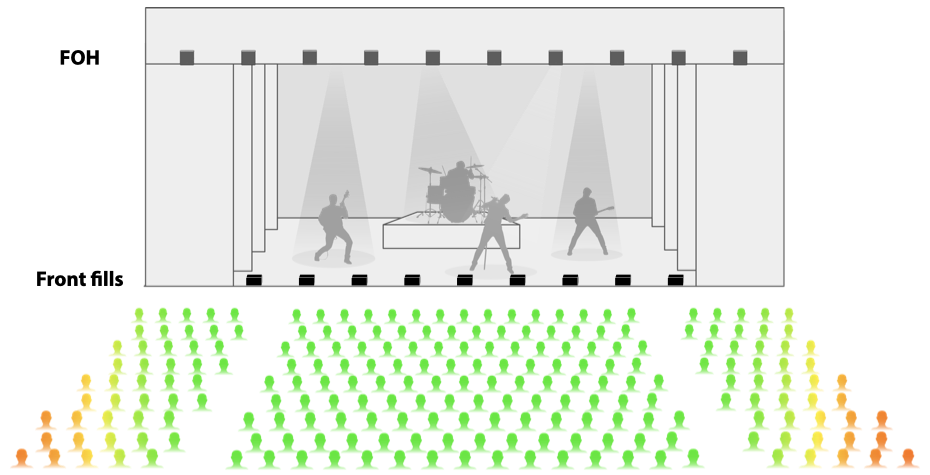
The deployment of a WFS line is determined by the listening zone to be covered. The main system (FOH) will not encounter major constraints regarding its positioning, unlike a front-fill system whose proximity to the audience will impose certain considerations such as the critical distance.
In HOLOPHONIX, the WFS algorithm also allows control of 3D systems, and therefore of immersive loudspeakers (surrounds).
Critical Distance (Spatialization Perception Limit)
The inter-loudspeaker spacing (inter-acoustic distance) is also constrained by the distance between the WFS line and the listeners.
Indeed, it can be considered that for correct spatialization, the listener must be within the coverage field of at least 3 loudspeakers. Taking into account the opening angle (useful radiation angle) of the loudspeakers, the minimum required density can be defined. If the inter-acoustic spacing is large, the audience will need to be set back further, or the front rows will have degraded spatialization. This is therefore a quantity that depends on both the inter-acoustic spacing and the useful radiation angle of the loudspeakers.
(D_{critical}=2.d_{step}.tan(frac {pi} {2} – frac {beta_{ls}} {2}))
- (d_{step}): inter-acoustic spacing.
- (beta_{ls}): useful radiation angle (in radians).
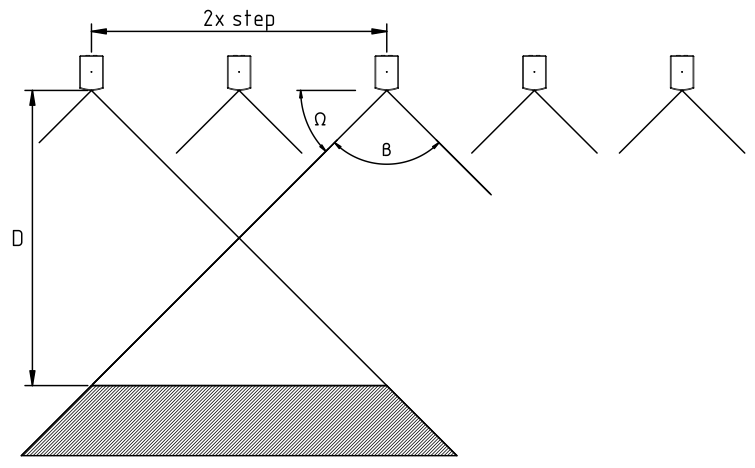
as a function of the inter-acoustic spacing (d_{step}) and the useful radiation angle (beta_{ls}) of the loudspeakers.
Front-fills
WFS allows each front-fill loudspeaker to be managed individually, in order to provide sound localization even for the front rows. Taking into account the critical distance mentioned above, the loudspeaker density is generally higher on a front-fill than on the main high-throw system (FOH).
Furthermore, the extreme proximity of listeners to the loudspeakers means that sound localization may not be optimal when sound sources are positioned near the front of the stage (where the WFS line is located). In this situation, only a few loudspeakers are used, leaving certain areas of the front-fill without sound signal.
To address this inherent WFS limitation, HOLOPHONIX has developed, in partnership with Ircam, the Théâtre National de Chaillot and the Festival d’Avignon, a dedicated optimization for front-fill lines. Called LSO (for Large Stage Optimization), it enables a level compensation activated only when sound sources are close to the loudspeaker line.
Delays and Under-Balcony Fills
As with traditional systems, the integration of WFS in HOLOPHONIX allows management of delay fill lines. Each loudspeaker is thus driven individually rather than providing a mono sum, in order to preserve localization. Obviously, as with a front-fill array, the proximity of listeners must be taken into account depending on the situation.