
WFS on High-Density Lines
By increasing loudspeaker density, WFS can offer localization of remarkable precision, even giving the illusion of depth and thereby achieving the effect known as “holophony”.
Such a high-density loudspeaker array can be heard at the ESPRO auditorium at Ircam, which features 280 Amadeus PMX5 loudspeakers forming four WFS lines, driven by the technology at the heart of the HOLOPHONIX audio engine. On the front array, the loudspeakers have an inter-acoustic spacing[1] of 16 cm. With this system, engineers can play with the depth effect, as well as position virtual sources in front of the loudspeaker line. This so-called “focus” zone is reserved for high-density WFS lines.
WFS in Sound Reinforcement
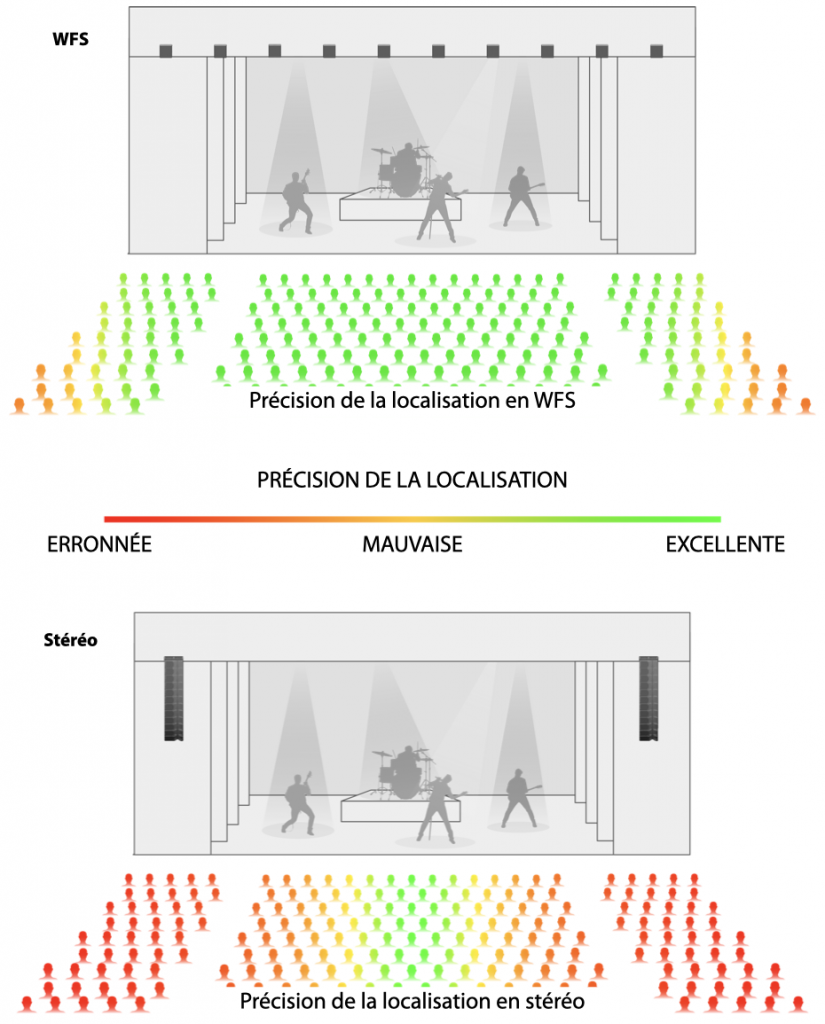
In our sound reinforcement practice, it is obviously not possible to achieve such loudspeaker density. However, despite a smaller number of loudspeakers, WFS — while unable to ideally reproduce depth — will still allow the direction of all sources to be reproduced independently of the listening position.
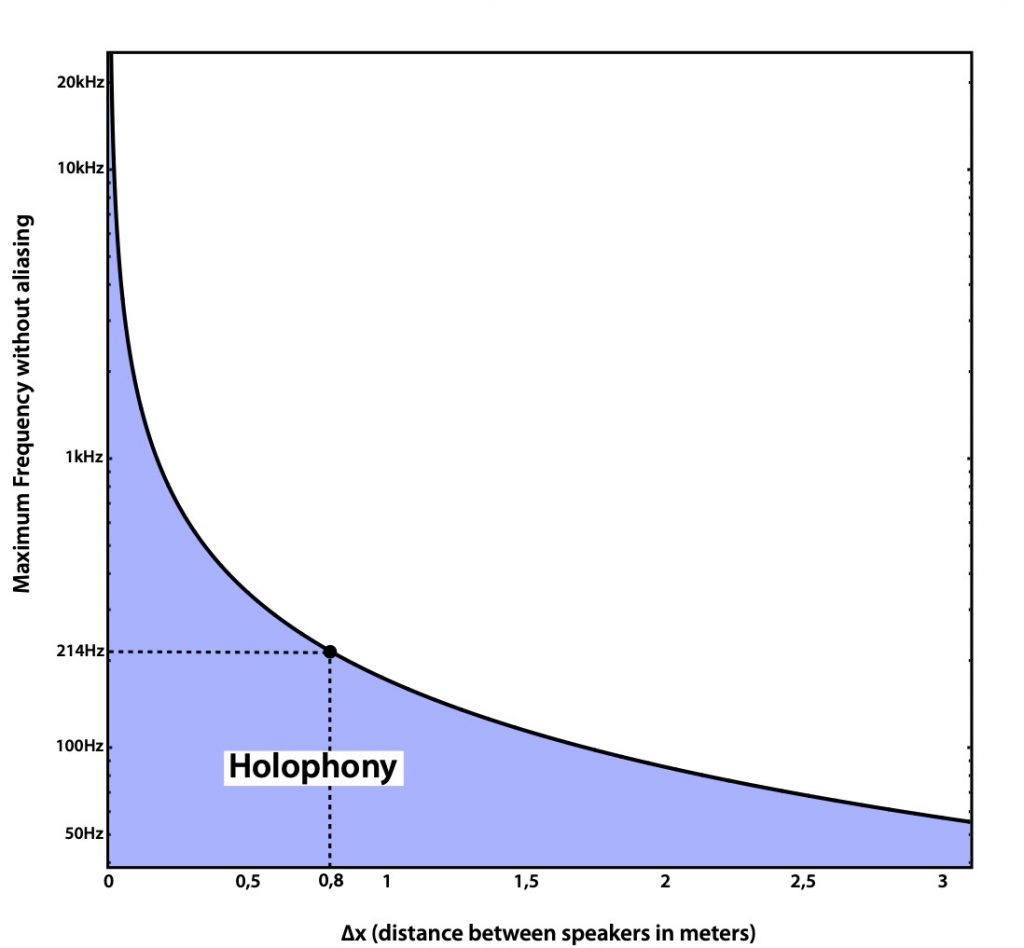
In venues equipped with WFS, the spacing between loudspeakers of the main “Front Of House” (FOH) system ranges from 1 m to 2 m. This provides excellent localization in the frontal plane. Ideally, the smaller this spacing — increasing the line density (number of loudspeakers) — the more finely the WFS line can reconstruct (spatially speaking) a secondary wavefront identical to that of a source (primary wave). In theory, the inter-acoustic spacing (the step between each loudspeaker) defines the smallest reconstructible wavelength and therefore the maximum frequency of the ideally reconstructed wavefront (holophony). This frequency is given by:
(F_{max}=frac {c} {2.d_{step}})
- (c): speed of sound in air ((simeq340 m/s)).
- (d_{step}): inter-acoustic spacing between loudspeakers.
Here, the WFS line is assumed to be very long compared to the dimensions of the listening zone (infinite length). The graph below illustrates this relationship, and holophony will be possible for frequencies below (F_{max}). This means that beyond this so-called aliasing frequency, waves are not uniformly reproduced spatially as a function of frequency (at different points in the listening zone).
An Algorithm Without a Sweet-Spot
Since WFS focuses on reconstructing a natural spherical wavefront using finely calculated delays and level differences, every listener is able to perceive the sound as coming from the desired direction, regardless of their position within the previously identified and calibrated coverage zone.
[1] The inter-acoustic spacing is the distance between the centres of each loudspeaker.