
History
Wave field synthesis was developed in the late 1980s at Delft University in the Netherlands by A.J. Berkhout in what was originally research on seismic waves. This process is extremely appealing for sound reinforcement applications because it promises to synthesize a realistic acoustic field. That is, with this holophony process [1] (a sonic hologram), it would be and it will be possible to position a sound source at a precise point in space, to simulate its emission from that point, and to thereby perceive the naturally associated acoustic field, whether or not the source is physically present.
In 1997, Evert Walter Start, a doctoral student at Delft University under A.J. Berkhout, became interested in using WFS in a sound reinforcement context[2]. In his thesis, he studied the 3 scientific principles at work in WFS, and devoted two chapters to the design and evaluation of WFS sound reinforcement systems.
Subsequently, several research centres (such as the STMS laboratory at IRCAM) deepened the use of this algorithm for real-time applications and sound reinforcement. However, this is not a new idea (figure below), as in 1953 William B. Snow, in an article on stereophony in the “Journal of the SMPTE”, published a diagram entitled “the perfect stereophonic system” which actually applies the WFS principle[3].
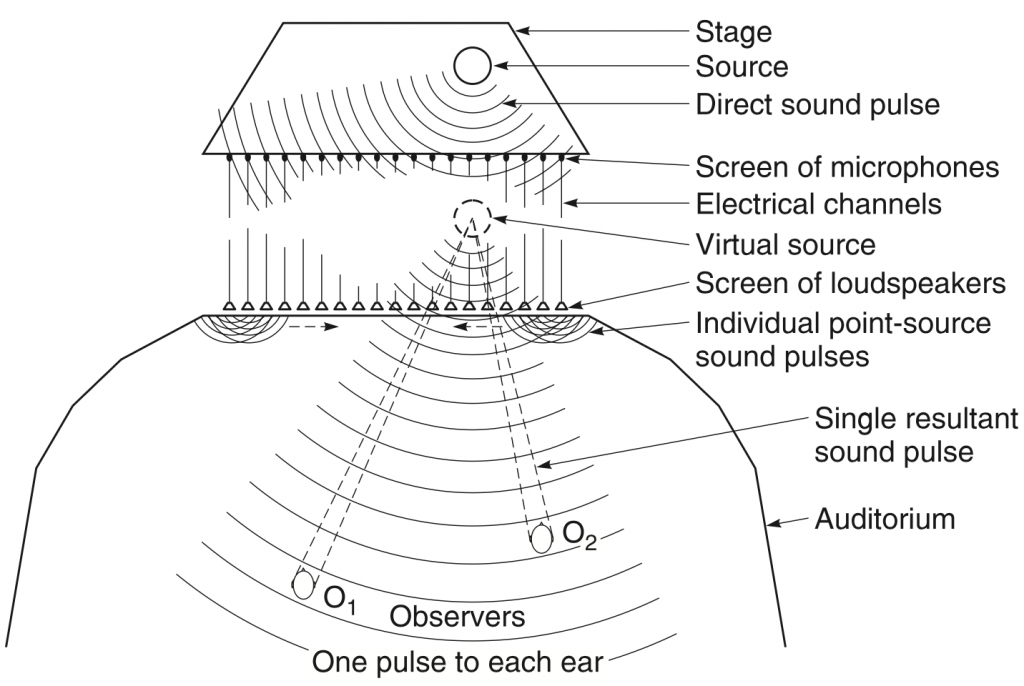
The ideal reproduction system according to W. B. Snow. (Rumsey 2001)
Operating Principle
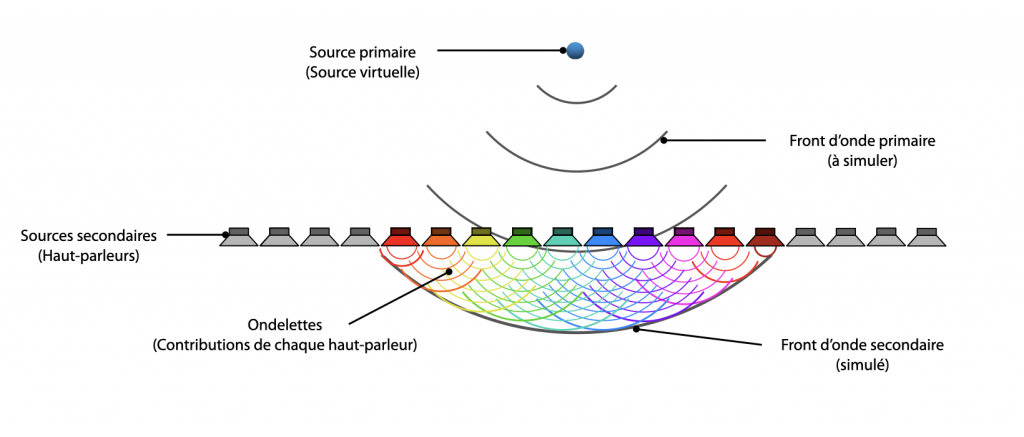
The operation of WFS is based on Huygens’ principle, published in 1690 in his Treatise on Light. This states, in essence, that a wavefront emitted by a primary source can be considered as the sum of the contributions of a set of secondary sources emitting wavelets. Together, they contribute to generating a secondary wavefront, at every point identical to the primary wavefront.
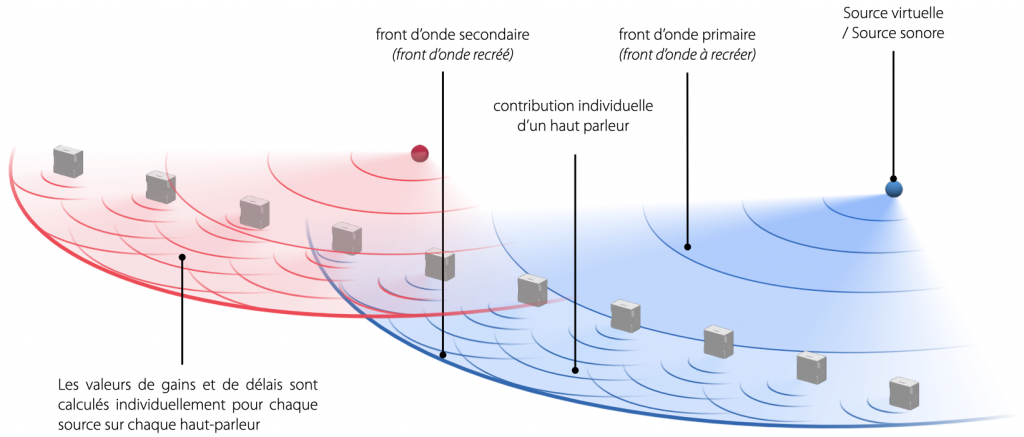
Principle of spherical wavefront reconstruction of a sound source through the contribution of a linear array of secondary sources
(WFS line)
More simply, when a sound is emitted, it propagates through space in the form of a spherical wavefront. WFS aims to reproduce this wavefront using multiple loudspeakers forming a line (figure above). The algorithm relies on level and delay differences between the loudspeakers. Ultimately, the contributions of these loudspeakers (re)construct a simulated wavefront (called the secondary wavefront) which is in theory identical to the primary wavefront.
In practice, a different gain and delay is applied to each loudspeaker for each sound source. The use of traditional amplitude panning is therefore set aside for spatialization.
[1] Holophony is an analogy with holography and not with the recording system developed by Hugo Zuccarelli based on a hypothesis of interferometry of the internal auditory system.
[2] E. W. Start, “Direct sound enhancement by wave field synthesis,” 1997.
[3] W. B. Snow, “Basic principles of stereophonic sound,” IRE Transactions on Audio, Vol. AU-3, pp. 42-53, 1955