
Like WFS, Ambisonics is a spatialization technique based on acoustic field synthesis. Whether we are working in stereo, on a multi-loudspeaker system with amplitude panning, WFS, or Ambisonics, the loudspeaker arrangement is constrained in order to reproduce spatialization. The great advantage of Ambisonics, beyond its versatility across different loudspeaker configurations, is the ability to offer decoding compensation parameters in order to adapt to system constraints while preserving a previously authored spatial sound scene (Ambisonics mix).
A useful mnemonic for approaching Ambisonics is the acronym O.N.O.: Order – Normalisation – Organisation:
Organisation: organisation of the Ambisonics channels according to FMH, SID, ACN. ACN is the reference.
Normalisation: FuMa, N3D, SN3D. SN3D is the reference.
Order: Ambisonics encoding order, or spatial sampling order in spherical harmonics. The higher the order, the more precise the spatialization.
We can also draw a broader distinction between synthesis Ambisonics and reproduction Ambisonics.
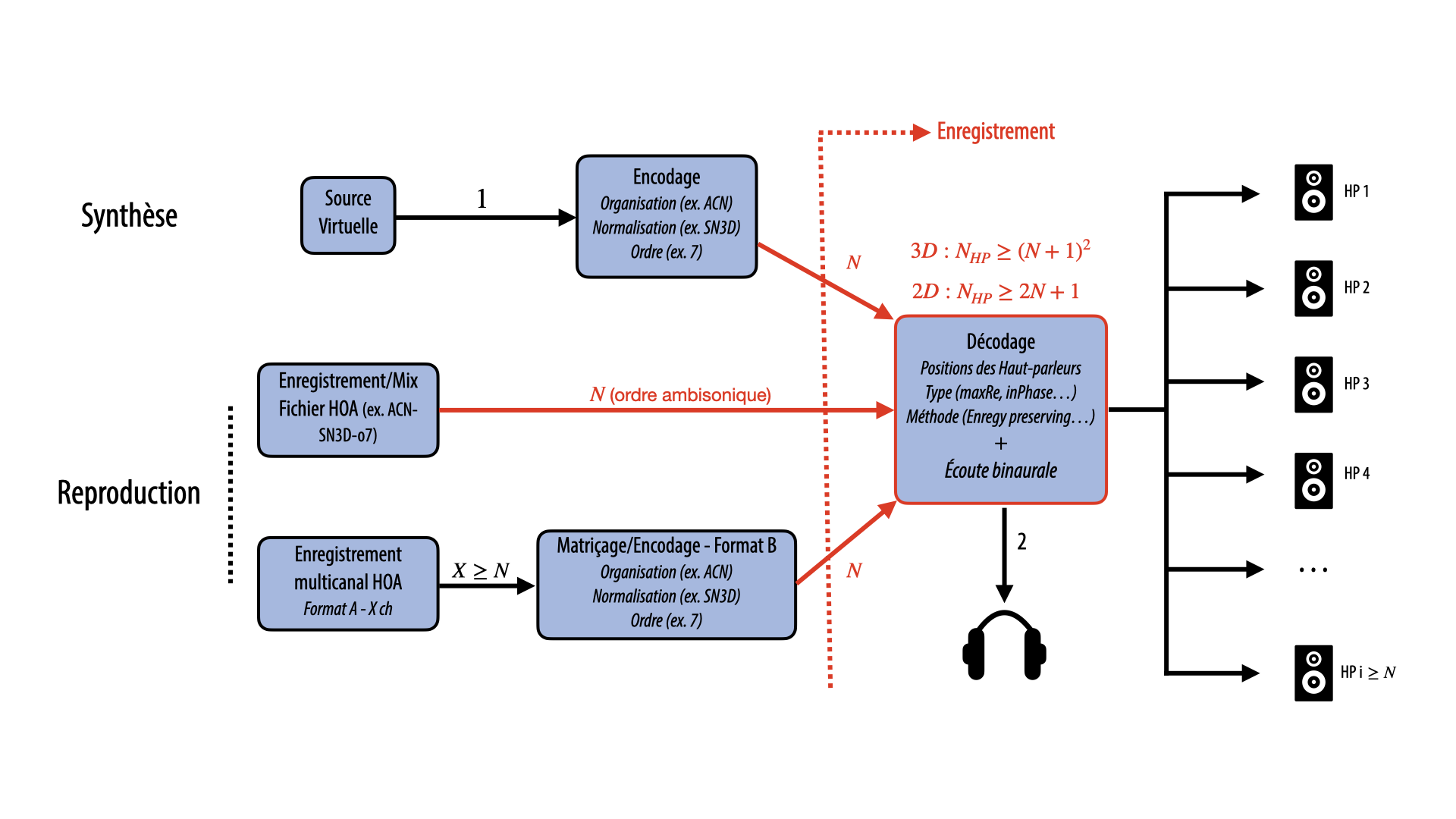
The first approach, the most common in Holophonix, generates the acoustic field of a sound source encoded in a multi-channel Ambisonics (HOA) stream (W, Y, Z, X, …) that is immediately decoded on the loudspeaker array.
The second approach allows Holophonix to play back a multi-channel HOA audio file (W, Y, Z, X, …) — which is the representation of a previously mixed acoustic field (ACN SN3D or SN2D file) — for decoding on the loudspeaker array. Typically, a mix can be reproduced on different systems: in different venues with different loudspeaker layouts. This embodies the full versatility of the technology.
Furthermore, it will be possible to start from the raw multi-channel stream coming from a multi-channel HOA microphone (Eigenmic, Soundfield, …) — known as A-format (which is historically more associated with first order). This stream must first be encoded (matrix processing) specifically, unlike synthesis Ambisonics, in order to generate the associated HOA stream. From there, the acoustic field captured by an HOA microphone can be decoded on the loudspeaker array. Finally, Holophonix allows listening to (as a simulation of acoustic rendering) a 3D binaural version of a decoding on the loudspeaker array: simulation. This technique applies HRTF filters specific to the position of each loudspeaker involved. It gives the brain the illusion of a surrounding 3D acoustic field.
Advantages:
- Immersive and enveloping diffusion.
- All loudspeakers contribute to the reproduction of sound sources, creating homogeneous spatial coverage.
- Robust to listener or source movement.
Disadvantages:
- Less precise localization (especially at lower orders).
- Less impactful reproduction on transients and reduced sense of directivity.
- Peripheral spatial rendering can be blurry.
- Optimized for a central listening zone.