
First-order Ambisonics (3D)
After extending the MS encoding/decoding principle, we identified that in 2D, the combination of an omnidirectional directivity pattern with two perpendicular bidirectional patterns allows the horizontal plane to be fully described.
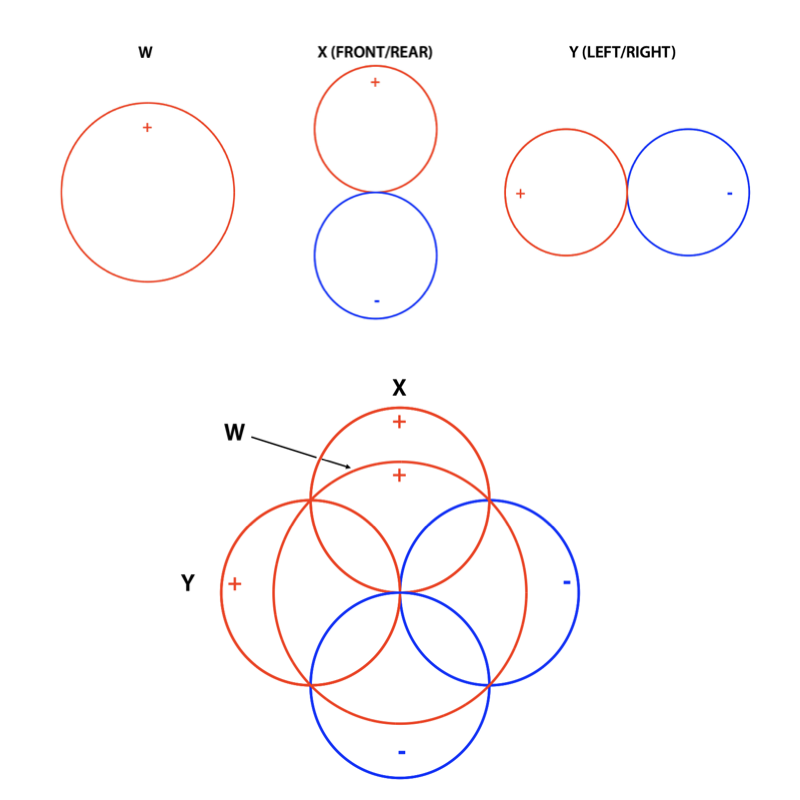
With 3D Ambisonics, the stream will simply add a new component: the Z channel, on the vertical axis. It can be decoded to at least four loudspeakers surrounding the listener, with elevation.
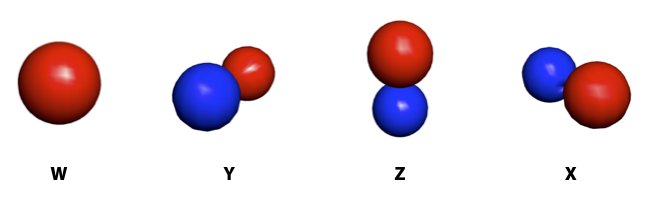
In the image above, the harmonic ordering differs in its formulation: WYZX rather than WXYZ. This will be explained later for higher encoding orders in order to facilitate their identification.
Higher Order Ambisonics (HOA)
The decomposition of space (also called spatial sampling) into several directional portions can be extended with more components presenting more precise directivity patterns: Higher Order Ambisonics.
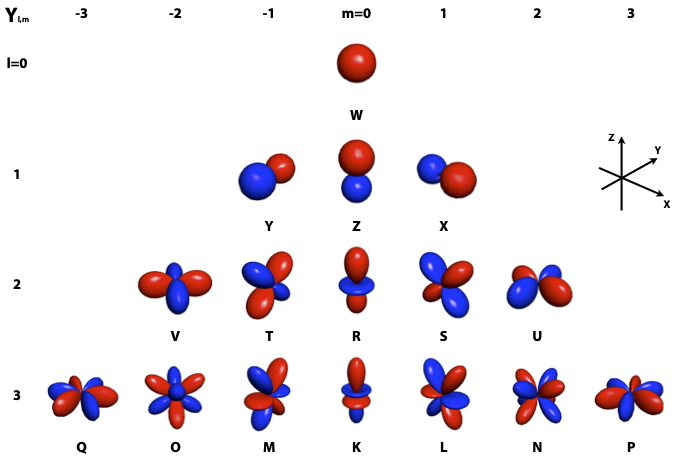
ACN organisation of the spherical harmonics (Y_{l,m}) as a function of the sampling order (l) of space.
These Ambisonics components are called “spherical harmonics”, by analogy with the decomposition of a sound into a Fourier series: any periodic signal can be considered as a sum of sinusoidal functions of different frequencies and amplitudes (its harmonics). Similarly, space — mapped onto a sphere around the listener — can be subdivided into spatial functions which, when summed, allow that space to be described.
This is also referred to as a spatial Fourier transform to describe this sampling process.
The Ambisonics order defines the number of channels in the encoding stream (the Ambisonics stream). Order 1 (in 3D) includes the first 4 channels (W, Y, Z, X), order 2 includes the first 9 channels, and so on.
The number of harmonics and therefore the number of channels in an Ambisonics stream as a function of the encoding order is given by the following relations, depending on whether we are in 2D or 3D:
(N_{channels} = begin{cases} 2 * N_{order} + 1 & text{: 2D} \ (N_{order} + 1)^2 & text{: 3D} end{cases})
The higher the Ambisonics order, the more precisely space is sampled, and the greater the number of loudspeakers (N_{LS}) on which an Ambisonics stream (containing (N_{channels})) can be decoded with increased accuracy: (N_{LS}ge N_{channels}).
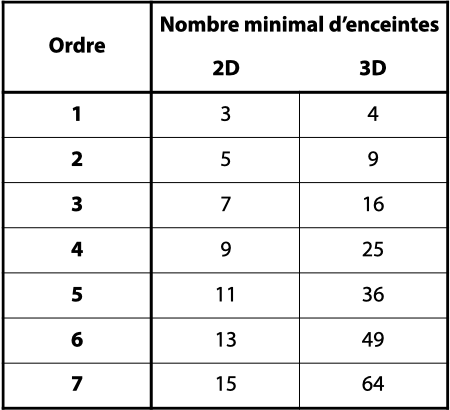
To summarize:
- In 2D: (N_{LS}ge 2 times N_{order}+1)
- In 3D: (N_{LS}ge (N_{order} + 1)^{2})
In practice, each channel of the stream is specific (W, X, Y, Z, …). It is identified for decoding. Their ordering follows an ACN organisation so that each can be identified, and each is assigned a normalisation weighting (N3D or SN3D). For the user, these details are transparent since they are generally concerned with source positioning. However, if they wish to play back a spatialized sound scene previously encoded as an Ambisonics stream (at a specific order), the recording of that stream must specify:
- the order
- the organisation (FMH, SID, ACN)
- the normalisation (maxN, FuMa, N3D, SN3D)
For example, an FMH or SID organisation at order 1 will specify the arrangement of the 4 stream channels (channels 1 to 4) as WXYZ, while ACN uses WYZX. The ACN-SN3D combination is the most common (the Ambix multi-channel HOA file format).