
Sound source localization means, on the one hand, identifying its direction of emission, and on the other hand, appreciating its distance.
But these questions cannot be addressed without considering its directivity. As an inseparable prerequisite to its localization, a source’s ability to project acoustic information toward a listener is not homogeneous across all frequencies.
Perception of Direction
Our perception of direction — i.e., the angle of incidence of an acoustic wave coming from a source — is based primarily on three phenomena called “localization cues”: IID (Interaural Intensity Differences), ITD (Interaural Time Differences), and HRTFs (Head Related Transfer Functions). These cues result from the difference in path length (distance to travel) of the wave to reach each of our two ears. But other non-negligible characteristics such as the law of the first wavefront also play a role in localization.
Generally, we can note that our perceptual capabilities will favor the frontal plane [1]:
- – In the horizontal plane, angular blur is approximately 3° facing the listener [2] and increases to approximately 10° at the sides (±90°), then decreases to approximately 6° at the rear, for a 100ms pulse of noise at 70 phons.
- In the vertical plane for speech signals, angular blur is approximately 9° facing the listener and increases to approximately 22° above (90° elevation) and approximately 27° at the rear. Elevation suffers from significant perceptual confusion.
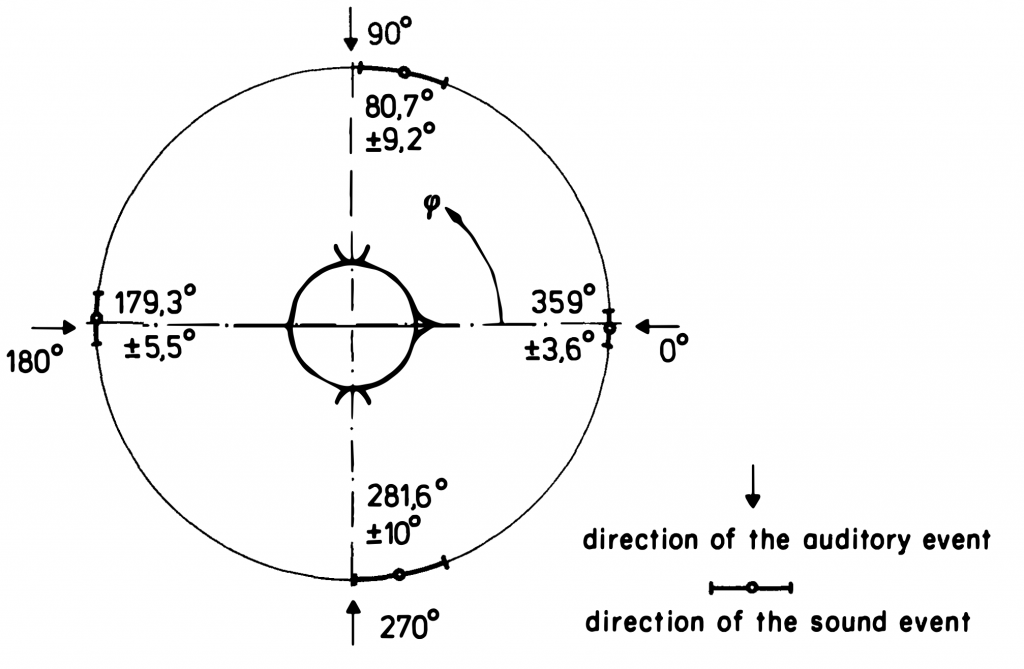
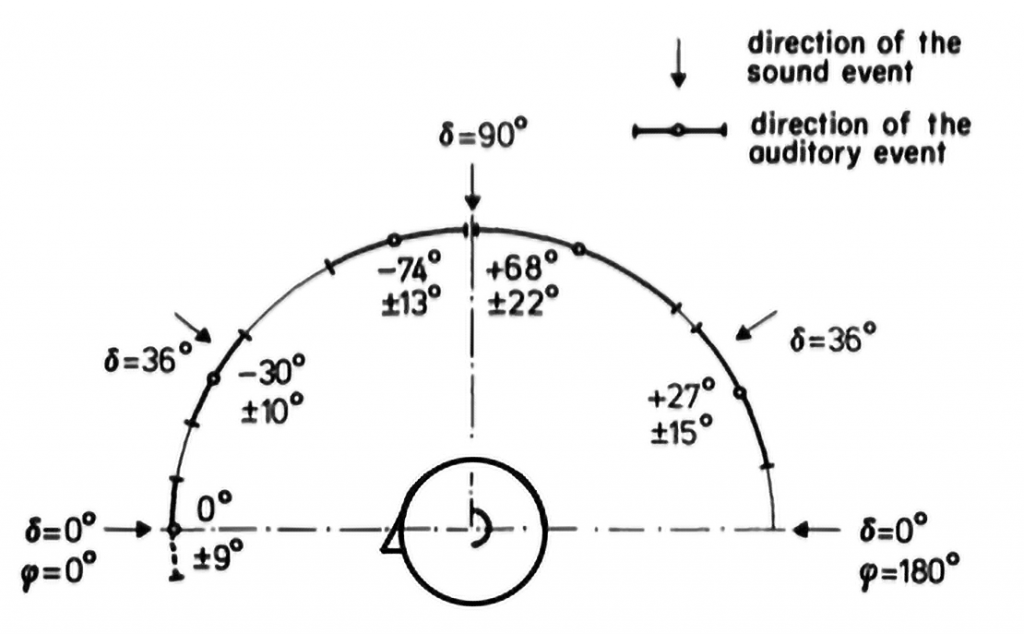
Thus, the frontal plane relative to the listeners should be prioritized to ensure identification of the spatial details of a sound scene.
Interaural Intensity Difference (IID)
Called IID (Interaural Intensity Differences) or ILD (Interaural Level Differences), the sound intensity differences between the two ears (interaural) are mainly due to the masking caused by the head and are illustrated in the following figure.
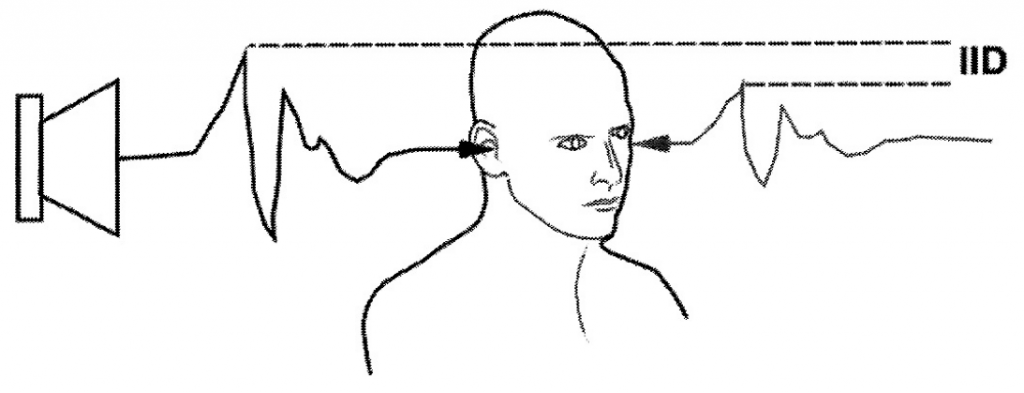
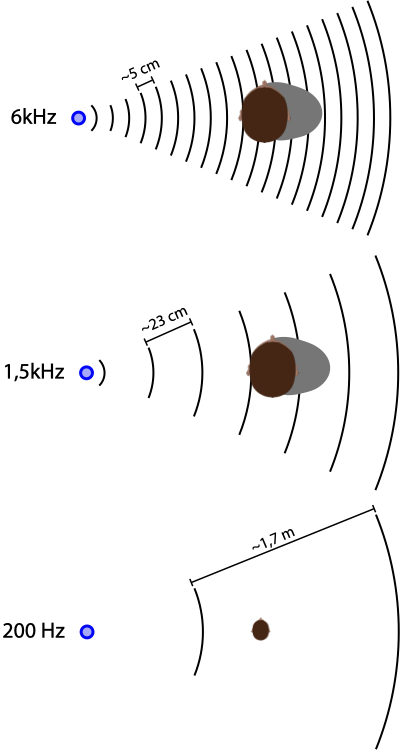
The head is a non-negligible obstacle in the propagation of a sound wave. A sound wave is a complex composition of frequencies and therefore of different wavelengths. Depending on their sizes, they will be more or less affected by the equally complex dimensions of our head. Thus, the perceived intensity of a sound source located at 90° from a listener will differ from one ear to the other. Facing the listener, both ears will perceive virtually (despite the asymmetry of the head) the same intensity, the same level.
This masking will affect short wavelengths and therefore high frequencies. Perceptually, IID will be predominant for frequencies above 1.5 kHz.
Conversely, long wavelengths, for frequencies below 200 Hz, will produce almost no significant intensity differences between the two ears, preventing localization.
Interaural Time Difference
Called ITD (Interaural Time Differences), differences in arrival time are simply due to the propagation time of sound and the difference in path length of a sound wave to reach each ear (following figure).
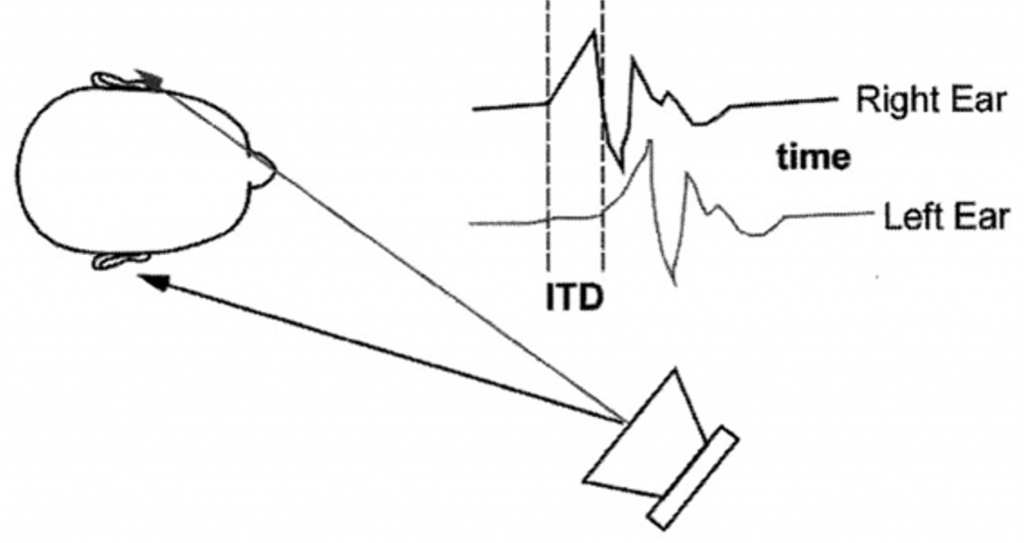
The width of our head induces a difference in the arrival time of sound between our two ears, varying with the position of the source as illustrated in the preceding figure[3]. When the source is at the center, facing the listener or behind, the time offset is zero; when the source is to the side, it can reach 0.65 ms (sound propagation time over the distance separating our two ears, approximately 17 cm).
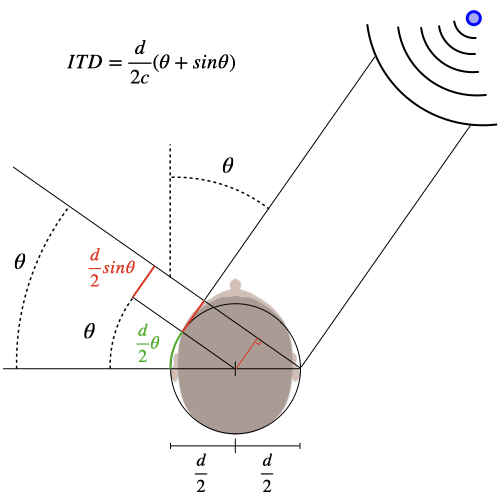
Localization via path length differences (interaural time difference) is predominant for frequencies up to 1.5 kHz and then diminishes beyond that.
However, the sound envelope (the variation in intensity of a sound) contributes to the “temporal” localization of a sound: the attack and decay of a sound accentuates the perception of the time difference. This localization via a sound’s envelope occurs regardless of its spectral content and therefore regardless of its pitch (from 100-200 Hz onwards) [1].
The Cone of Confusion
Considering IID and ITD cues alone constitutes a theoretical approach called the “duplex” theory. This approach remains limited, however, as it only describes the lateralization of sources in the horizontal plane. When a source is equidistant from both ears, these cues are zero and do not allow elevation to be evaluated or identification of whether the source is in front or behind. There are zones of space in which IID and ITD are constant and do not allow the auditory system to differentiate. These zones are called “cones of confusion” (following figure).
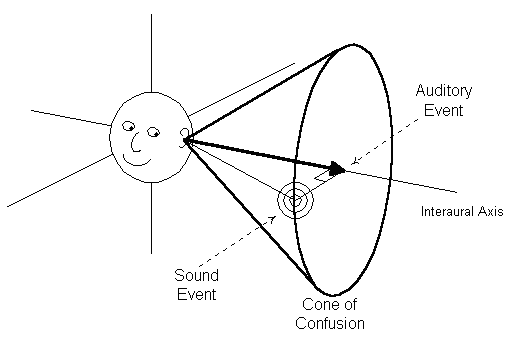
The interaural IID and ITD differences must be supplemented by spectral cues that describe the spectral differences perceived by each ear. IID and ITD are limited to describing the lateralization of sources in the horizontal plane. Spectral cues allow the inclusion of the sensation of elevation. We will primarily note the role of the shape of the head and body in modifying the spectrum.
HRTFs: A Head-Related Filtering
The shapes of our head, torso and outer ear (pinnae) have an impact on the sound waves reaching them: a filtering specific to each ear and each individual (following figure). These differences, which could be described as “interaural filtering differences”, will strongly contribute to the localization of a source in space (in front of, behind or above us).
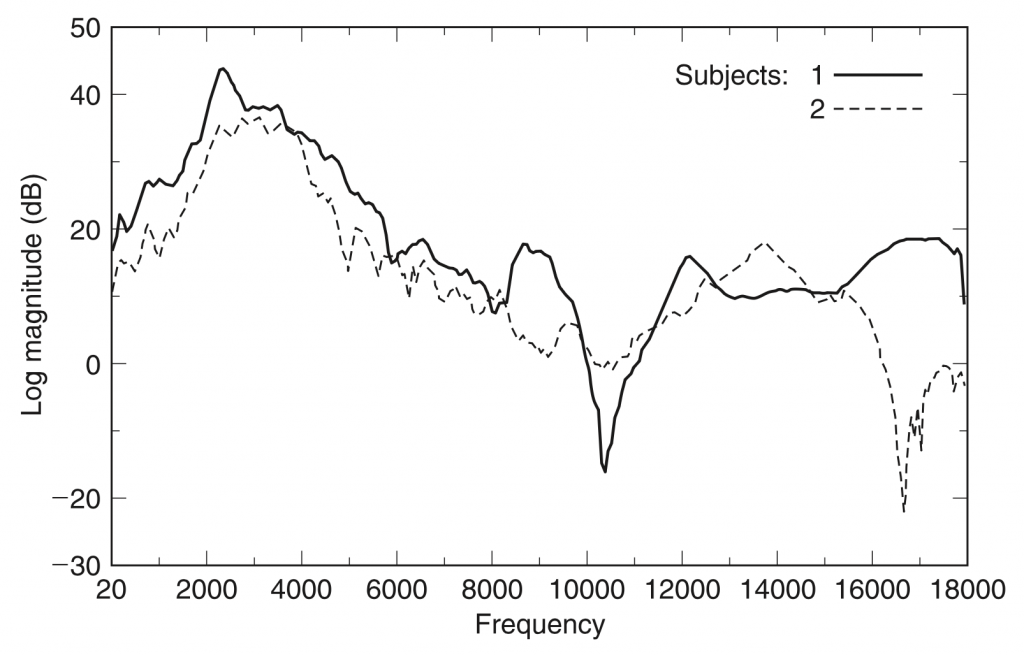
For each ear, this filtering illustrated in the following figure varies with the angle of incidence of the source [1]. It can be measured for an individual and allows a catalog of filters specific to several angles of incidence to be compiled. These filters, also called head-related transfer functions, constitute the HRTFs (Head Related Transfer Functions).
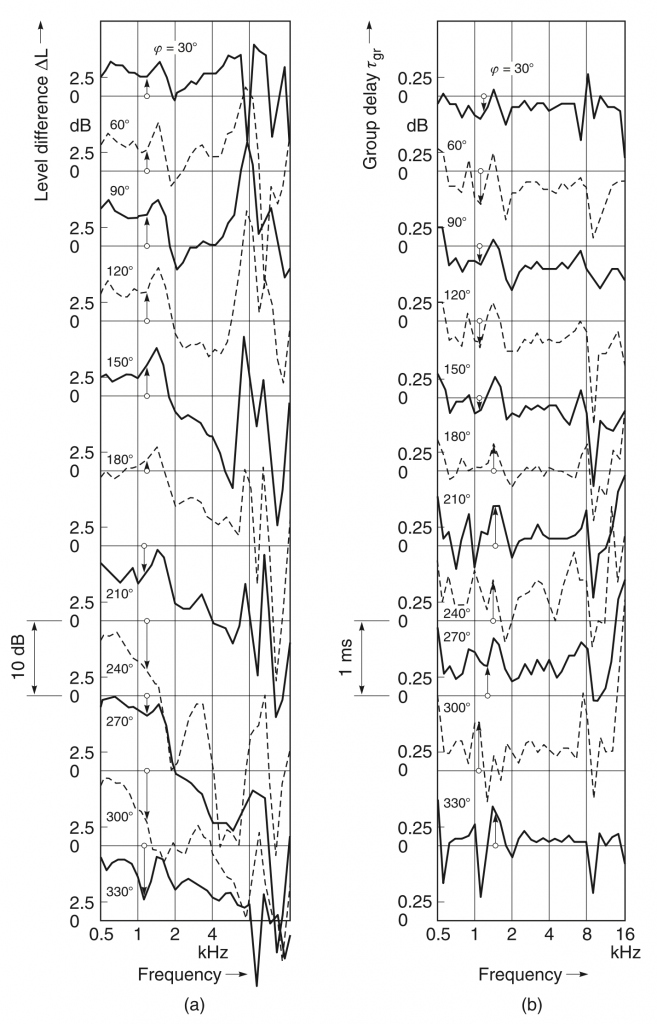
On the one hand, we can conclude that these interaural filtering differences mean that the intensity perceived by each of our two ears is different.
Intensity integrates the entire frequency spectrum. Attenuating a frequency band decreases the overall perceived intensity.
On the other hand, ILD, ITD and HRTF only partially inform us about the localization of a source. Only the direction of origin is interpreted (the angle of incidence). Distance is partially appreciated through the attenuation of high frequencies (absorption by air), provided our auditory memory informs us of it, or that the source or the listener is in motion.
Finally, we can add that reflexive head movements allow the auditory system to resolve ambiguities and refine the direction of emission of a source.
[1] J. Blauert, Spatial Hearing, the psychophysics of human sound localization, 2nd ed., MIT Press, 1997.
[2] Resolution actually varies from 0.9° to 4° depending on the nature of the signal.
[3] M. Wenzel, D. R. Begault and M. Godfroy-Cooper, Immersive Sound – The Art and Science of Binaural and Multi-Channel Audio: Perception of Spatial Sound, A. Roginska and P. Geluso, Eds., 2017.