Holophonix includes a wide range of spatialization technologies. The nature of the sources, the goals and their resulting requirements, and the characteristics of the implemented diffusion system will be the main criteria for choosing one algorithm over another.
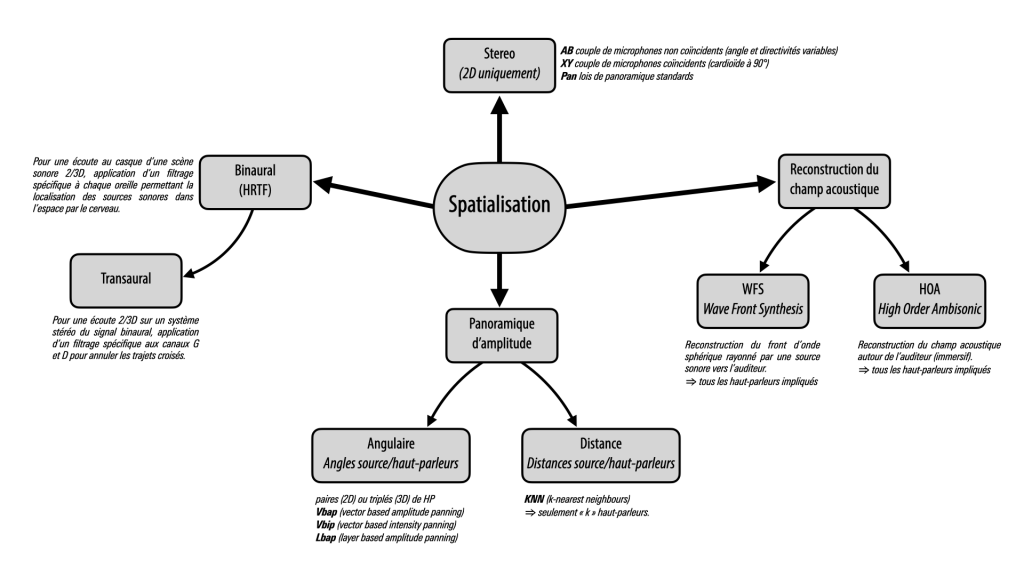
There are three main technology families involved in sound spatialization in the broad sense:
- Amplitude or intensity panning algorithms (VBAP, LBAP, KNN…);
- Acoustic field reconstruction/simulation algorithms (WFS, Ambisonics);
- Two-channel spatial virtualization algorithms (Stereo, Binaural, Transaural).
Traditional stereophony can be included in the virtualization family, as it reproduces spatialized phantom sources between the two left and right loudspeakers.
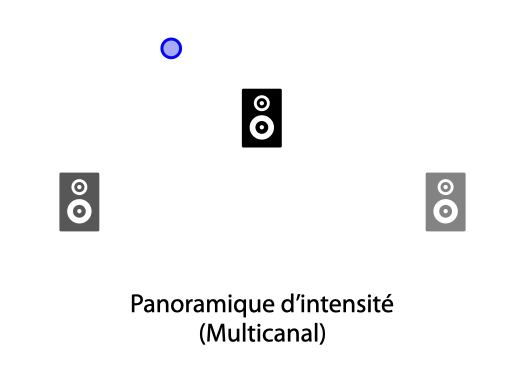
Amplitude panning algorithms work, as discussed previously, on the basis of level differences between loudspeakers to form a phantom image between them.
Acoustic field reconstruction algorithms allow a sound source to be reproduced locally with excellent fidelity, even if it is not physically present in the space. This reproduction technique is called Holophony.
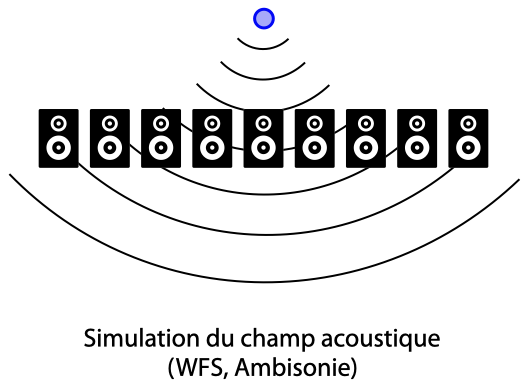
WFS and HOA are acoustic field reconstruction algorithms that, in theory, can achieve Holophony. WFS reproduces the acoustic field emitted by a source. Ambisonics (HOA) reproduces the acoustic field as perceived by the listener. In practice, WFS delivers excellent localization results for sound reinforcement, while Ambisonics is preferred for immersive reproduction.
Finally, Binaural (headphone spatialization) and Transaural (individual spatialization on a single pair of loudspeakers) allow, through the use of HRTFs, the simulation of the filtering associated with our head, creating the illusion of a 3D reproduction using a pair of headphones or earphones (in the binaural case).